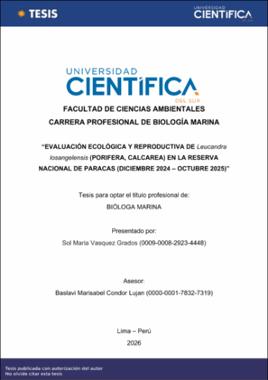
Evaluación ecológica y reproductiva de Leucandra losangelensis (Porifera, Calcarea) en la reserva nacional de Paracas (diciembre 2024 – octubre 2025)
| dc.contributor.advisor | Condor Lujan, Baslavi Marisbel | |
| dc.contributor.author | Vasquez Grados, Sol Maria | |
| dc.date.accessioned | 2026-09-30T00:51:52Z | |
| dc.date.available | 2026-09-30T00:51:52Z | |
| dc.date.issued | 2026 | |
| dc.identifier.uri | https://hdl.handle.net/20.500.12805/7015 | |
| dc.description.abstract | Long-term monitoring of sessile invertebrates is essential for establishing ecological baselines in Marine Protected Areas (MPAs) and understanding population responses to environmental variability. Sponges play key roles in benthic ecosystems, contributing to nutrient cycling and habitat complexity, yet important aspects of their biology remain poorly understood, especially in the Southeastern Pacific. This study characterized the population structure and reproductive biology of the calcareous sponge Leucandra losangelensis (de Laubenfels, 1930) in the Paracas National Reserve (PNR) (Ica, Peru), from December 2024 to October 2025. Environmental parameters showed moderate seasonal variation without significant temporal differences. In contrast, sponge relative density showed the lowest value in December 2024 (0.10 ± 0.08 ind/m²) and gradually increased over the following months, peaking in April 2025 (0.68 ± 0.61 ind/m²). Continuous reproductive activity was evident, with a constant presence of oocytes and larvae, while embryos appeared intermittently. Larval density peaked at the beginning of the study (summer, December 2024), whereas oocyte density increased during winter months (July 2025). Variations in reproductive elements, size structure, and population density suggest the occurrence of recruitment processes during the study period. Furthermore, significant associations were detected between larval density and conductivity (p=0.045). These findings reveal temporal variability of the population structure and continuous reproductive activity, whereas abiotic parameters remained relatively stable throughout the study period. Together, these results provide the first population-level ecological and reproductive baseline for sponges in Peru, highlighting the relevance of sponge biology to understand benthic dynamics for establishing management and monitoring strategies in productive coastal MPAs of the Southeastern Pacific. | es_PE |
| dc.format | application/pdf | es_PE |
| dc.language.iso | eng | es_PE |
| dc.publisher | Universidad Científica del Sur | es_PE |
| dc.relation.ispartofseries | PRE-5-2023-00900 | es_PE |
| dc.rights | http://purl.org/coar/access_right/c_f1cf | es_PE |
| dc.rights.uri | https://creativecommons.org/licenses/by-nc-sa/4.0/ | es_PE |
| dc.subject | Calcaronea | es_PE |
| dc.subject | Área Marina Protegida | es_PE |
| dc.subject | Laguna Grande | es_PE |
| dc.subject | Population dynamics | es_PE |
| dc.subject | Sponge | es_PE |
| dc.subject | Reproduction | es_PE |
| dc.title | Evaluación ecológica y reproductiva de Leucandra losangelensis (Porifera, Calcarea) en la reserva nacional de Paracas (diciembre 2024 – octubre 2025) | es_PE |
| dc.type | http://purl.org/coar/resource_type/c_7a1f | es_PE |
| thesis.degree.discipline | Biología Marina | es_PE |
| thesis.degree.grantor | Universidad Científica del Sur. Facultad de Ciencias Ambientales | es_PE |
| thesis.degree.name | Bióloga Marina | es_PE |
| dc.subject.ocde | https://purl.org/pe-repo/ocde/ford#1.06.12 | es_PE |
| dc.publisher.country | PE | es_PE |
| renati.advisor.dni | 43644365 | |
| renati.advisor.orcid | https://orcid.org/0000-0001-7832-7319 | es_PE |
| renati.author.dni | 70656921 | |
| renati.discipline | 51103248 | es_PE |
| renati.juror | Valle Rubio, Sonia Ruthy | |
| renati.juror | Jiménez Campeán, Analí | |
| renati.juror | Cuba Martínez, Antonio | |
| renati.level | https://purl.org/pe-repo/renati/level#tituloProfesional | es_PE |
| renati.type | https://purl.org/pe-repo/renati/type#tesis | es_PE |
| dc.type.other | -- Tesis de bachiller | es_PE |
| dc.type.version | http://purl.org/coar/version/c_ab4af688f83e57aa | es_PE |
Files in this item


This item appears in the following Collection(s)
-
Biología Marina [113]

Except where otherwise noted, this item's license is described as http://purl.org/coar/access_right/c_f1cf