Características clínicas y epidemiológicas de equinococosis quística en niños de un centro terciario en Perú
| dc.contributor.author | Salazar-Mesones, B. | |
| dc.contributor.author | Luna-Vílchez, M. | |
| dc.contributor.author | Maquera-Afaray, J. | |
| dc.contributor.author | Chiara-Chilet, C. | |
| dc.contributor.author | Portillo-álvarez, D. | |
| dc.contributor.author | López Revilla, J.W. | |
| dc.date.accessioned | 2025-10-31T18:40:35Z | |
| dc.date.available | 2025-10-31T18:40:35Z | |
| dc.date.issued | 2022 | |
| dc.identifier.uri | https://hdl.handle.net/20.500.12805/5829 | |
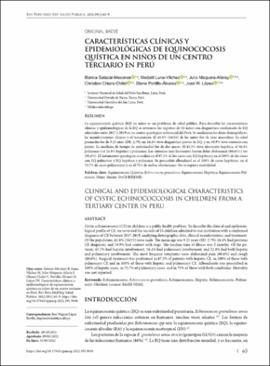
| dc.description.abstract | Cystic echinococcosis (CE) in children is a public health problem. To describe the clinical and epidemio-logical profile of CE, we reviewed the records of 55 children admitted to our institution with a confirmed diagnosis of CE between 2017-2019, analyzing demographic data, clinical manifestations, and treatment. Male sex was 61,8% (34/55), median age was 9,25+2,79 years; 16,4% had previous CE diagnosis, and 50,9% had contact with dogs. The median time of illness was 2 months. 65,5% had hepatic involvement, 56,4% had pulmonary involvement, and 21,8% had both hepatic and pulmonary involvement. The most frequent symptoms were abdominal pain (80,6%) and cough (80,6%). Surgical treatment was performed in 87,5% of hepatic CE and 100% of pulmonary CE and hepatic and pulmonary CE. Albendazole was prescribed in 100% of hepatic cases, in 73,7% of pulmonary cases, and 75% of both affections. No mortality was reported. | en_US |
| dc.description.abstract | La equinococosis quística (EQ) en niños es un problema de salud pública. Para describir las características clínicas y epidemiológicas de la EQ se revisaron los registros de 55 niños con diagnóstico confirmado de EQ admitidos entre 2017 y 2019 en un centro quirúrgico referencial del Perú. Se analizaron los datos demográficos, las manifestaciones clínicas y el tratamiento. El 61,8% (34/55) de los niños fue de sexo masculino. La edad promedio fue de 9,25 años (DE: 2,79); un 16,4% tuvo diagnóstico previo de EQ, y un 50,9% tuvo contacto con perros. La mediana de tiempo de enfermedad fue de dos meses. El 65,5% tuvo afectación hepática, el 56,4% pulmonar y el 21,8% hepática y pulmonar. Los síntomas más frecuentes fueron dolor abdominal (80,6%) y tos (80,6%). El tratamiento quirúrgico se realizó en el 87,5% de los casos con EQ hepática y en el 100% de los casos con EQ pulmonar y EQ hepática y pulmonar. Se prescribió albendazol en el 100% de casos hepáticos, en el 73,7% de casos pulmonares y en el 75% de ambas afectaciones. No se reporta mortalidad. | es_PE |
| dc.description.sponsorship | Se agradece a la Unidad de Desarrollo de Investigación, Tecnologías y Docencia (UDITD) del INSN-SB por el soporte brindado para el desarrollo del presente trabajo de investigación. | |
| dc.format | application/pdf | |
| dc.language.iso | spa | |
| dc.publisher | Instituto Nacional de Salud (Perú) | |
| dc.relation.ispartof | urn:issn:1726-4642 | |
| dc.rights | https://purl.org/coar/access_right/c_abf2 | |
| dc.rights.uri | https://creativecommons.org/licenses/by-nc-sa/4.0/ | |
| dc.subject | Echinococcosis and Cystic Lesions in Humans | en_US |
| dc.subject | Echinococcosis Prevalence and Control Strategies | en_US |
| dc.title | Características clínicas y epidemiológicas de equinococosis quística en niños de un centro terciario en Perú | es_PE |
| dc.title.alternative | Clinical and epidemiological characteristics of cystic echinococcosis in children at a tertiary care center in Peru | en_US |
| dc.type | https://purl.org/coar/resource_type/c_2df8fbb1 | |
| dc.identifier.doi | https://doi.org/10.17843/rpmesp.2022.391.9830 | |
| dc.subject.ocde | https://purl.org/pe-repo/ocde/ford#3.03.07 | |
| dc.type.other | Research article | |
| dc.identifier.journal | Revista Peruana de Medicina Experimental y Salud Pública | |
| dc.type.version | https://purl.org/coar/version/c_970fb48d4fbd8a85 |
Files in this item
This item appears in the following Collection(s)
-
Artículos de Investigación [1294]

Except where otherwise noted, this item's license is described as https://purl.org/coar/access_right/c_abf2