Avances genómicos de la última década y su influencia en el enfoque diagnóstico de la discapacidad intelectual.
| dc.contributor.author | Barriga, H.H.A. | |
| dc.date.accessioned | 2025-10-31T18:47:00Z | |
| dc.date.available | 2025-10-31T18:47:00Z | |
| dc.date.issued | 2021 | |
| dc.identifier.uri | https://hdl.handle.net/20.500.12805/6291 | |
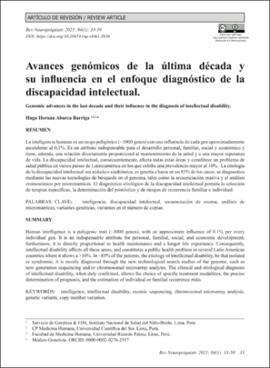
| dc.description.abstract | Human intelligence is a polygenic trait (~1000 genes), with an approximate influence of 0.1% per every individual gen. It is an indispensable attribute for personal, familial, social, and economic development; furthermore, it is directly proportional to health maintenance and a longer life expectancy. Consequently, intellectual disability affects all these areas, and constitutes a public health problem in several Latin American countries where it shows a >10%. In ~85% of the patients, the etiology of intellectual disability, be that isolated or syndromic; it is mostly diagnosed through the new technological search studies of the genome, such as new generation sequencing and/or chromosomal microarray analysis. The clinical and etiological diagnosis of intellectual disability, when duly confirmed, allows the choice of specific treatment modalities, the precise determination of prognosis, and the estimation of individual or familial recurrence risks. | en_US |
| dc.description.abstract | La inteligencia humana es un rasgo poligénico (~1000 genes) con una influencia de cada gen aproximadamente ascendente al 0,1%. Es un atributo indispensable para el desarrollo personal, familiar, social y económico y tiene, además, una relación directamente proporcional al mantenimiento de la salud y a una mayor esperanza de vida. La discapacidad intelectual, consecuentemente, afecta todas estas áreas y constituye un problema de salud pública en varios países de Latinoamérica en los que exhibe una prevalencia mayor al 10%. La etiología de la discapacidad intelectual sea aislada o sindrómica, es genética hasta en un 85% de los casos; se diagnostica mediante las nuevas tecnologías de búsqueda en el genoma, tales como la secuenciación masiva y el análisis cromosómico por micromatrices. El diagnóstico etiológico de la discapacidad intelectual permite la selección de terapias específicas, la determinación del pronóstico y de riesgos de recurrencia familiar e individual. | es_PE |
| dc.format | application/pdf | |
| dc.language.iso | spa | |
| dc.language.iso | eng | |
| dc.publisher | School of Medicine, Peruvian University Cayetano Heredia | |
| dc.relation.ispartof | urn:issn:1609-7394 | |
| dc.rights | https://purl.org/coar/access_right/c_abf2 | |
| dc.rights.uri | https://creativecommons.org/licenses/by-nc-sa/4.0/ | |
| dc.subject | Genetic Insights and Treatment Strategies in Leukemia | en_US |
| dc.subject | Genetic Screening and Exome Insights in Rare Diseases | en_US |
| dc.title | Avances genómicos de la última década y su influencia en el enfoque diagnóstico de la discapacidad intelectual. | es_PE |
| dc.title.alternative | Genomic advances in the last decade and their influence in the diagnosis of intellectual disability | en_US |
| dc.type | https://purl.org/coar/resource_type/c_dcae04bc | |
| dc.identifier.doi | https://doi.org/10.20453/RNP.V84I1.3936 | |
| dc.subject.ocde | https://purl.org/pe-repo/ocde/ford#3.01.00 | |
| dc.type.other | Review | |
| dc.identifier.journal | Revista de Neuro-Psiquiatria | |
| dc.type.version | https://purl.org/coar/version/c_970fb48d4fbd8a85 |
Files in this item
This item appears in the following Collection(s)
-
Artículos de Revisión [256]

Except where otherwise noted, this item's license is described as https://purl.org/coar/access_right/c_abf2