Evidence-based indications for ivermectin in parasitic diseases: An integrated approach to context and challenges in Peru
| dc.contributor.author | Failoc-Rojas, V.E. | |
| dc.contributor.author | Silva-Díaz, H. | |
| dc.contributor.author | Maguiña, J.L. | |
| dc.contributor.author | Rodriguez-Morales, A.J. | |
| dc.contributor.author | Díaz-Velez, C. | |
| dc.contributor.author | Apolaya-Segura, M. | |
| dc.contributor.author | Valladares-Garrido, M.J. | |
| dc.date.accessioned | 2025-10-31T18:46:30Z | |
| dc.date.available | 2025-10-31T18:46:30Z | |
| dc.date.issued | 2023 | |
| dc.identifier.uri | https://hdl.handle.net/20.500.12805/6256 | |
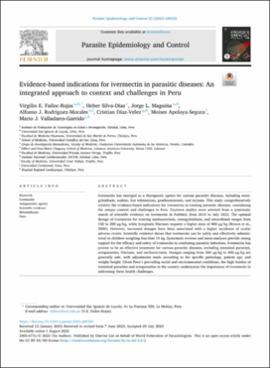
| dc.description.abstract | Ivermectin has emerged as a therapeutic option for various parasitic diseases, including strongyloidiasis, scabies, lice infestations, gnathostomiasis, and myiasis. This study comprehensively reviews the evidence-based indications for ivermectin in treating parasitic diseases, considering the unique context and challenges in Peru. Fourteen studies were selected from a systematic search of scientific evidence on ivermectin in PubMed, from 2010 to July 2022. The optimal dosage of ivermectin for treating onchocerciasis, strongyloidiasis, and enterobiasis ranges from 150 to 200 μg/kg, while lymphatic filariasis requires a higher dose of 400 μg/kg (Brown et al., 2000). However, increased dosages have been associated with a higher incidence of ocular adverse events. Scientific evidence shows that ivermectin can be safely and effectively administered to children weighing less than 15 kg. Systematic reviews and meta-analyses provide strong support for the efficacy and safety of ivermectin in combating parasitic infections. Ivermectin has proven to be an effective treatment for various parasitic diseases, including intestinal parasites, ectoparasites, filariasis, and onchocerciasis. Dosages ranging from 200 μg/kg to 400 μg/kg are generally safe, with adjustments made according to the specific pathology, patient age, and weight/height. Given Peru's prevailing social and environmental conditions, the high burden of intestinal parasites and ectoparasites in the country underscores the importance of ivermectin in addressing these health challenges. | en_US |
| dc.description.sponsorship | Thanks to the Health Technology Assessment and Research Institute of ESSALUD. | |
| dc.format | application/pdf | |
| dc.language.iso | eng | |
| dc.publisher | Elsevier | |
| dc.relation.ispartof | urn:issn:2405-6731 | |
| dc.rights | https://purl.org/coar/access_right/c_abf2 | |
| dc.rights.uri | https://creativecommons.org/licenses/by-nc-sa/4.0/ | |
| dc.subject | COVID-19, Its Impact, and Vaccination | en_US |
| dc.subject | Ivermectin's Role as an Antiviral Agent in COVID-19 | en_US |
| dc.title | Evidence-based indications for ivermectin in parasitic diseases: An integrated approach to context and challenges in Peru | en_US |
| dc.type | https://purl.org/coar/resource_type/c_dcae04bc | |
| dc.identifier.doi | https://doi.org/10.1016/j.parepi.2023.e00320 | |
| dc.subject.ocde | https://purl.org/pe-repo/ocde/ford#3.03.08 | |
| dc.type.other | Review | |
| dc.identifier.journal | Parasite Epidemiology and Control | |
| dc.type.version | https://purl.org/coar/version/c_970fb48d4fbd8a85 |
Files in this item
This item appears in the following Collection(s)
-
Artículos de Revisión [256]

Except where otherwise noted, this item's license is described as https://purl.org/coar/access_right/c_abf2