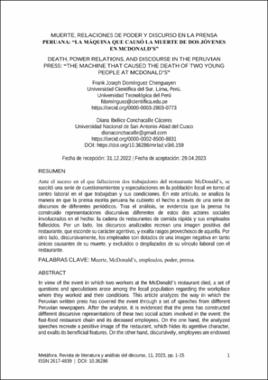
MUERTE, RELACIONES DE PODER Y DISCURSO EN LA PRENSA PERUANA: “LA MÁQUINA QUE CAUSÓ LA MUERTE DE DOS JÓVENES EN MCDONALD’S”
| dc.contributor.author | Chenguayen, F.J.D. | |
| dc.contributor.author | Cáceres, D.I.C. | |
| dc.date.accessioned | 2025-10-31T18:46:22Z | |
| dc.date.available | 2025-10-31T18:46:22Z | |
| dc.date.issued | 2023 | |
| dc.identifier.uri | https://hdl.handle.net/20.500.12805/6247 | |
| dc.description.abstract | In view of the event in which two workers at the McDonald’s restaurant died, a set of questions and speculations arose among the local population regarding the workplace where they worked and their conditions. This article analyzes the way in which the Peruvian written press has covered the event through a set of speeches from different Peruvian newspapers. After the analysis, it is evidenced that the press has constructed different discursive representations of these two social actors involved in the event: the fast-food restaurant chain and its deceased employees. On the one hand, the analyzed speeches recreate a positive image of the restaurant, which hides its agentive character, and exalts its beneficial features. On the other hand, discursively, employees are endowed with a negative image as the sole cause of their death and excluded or displaced from their employment relationship with the restaurant. | en_US |
| dc.description.abstract | Ante el suceso en el que fallecieron dos trabajadores del restaurante McDonald’s, se suscitó una serie de cuestionamientos y especulaciones en la población local en torno al centro laboral en el que trabajaban y sus condiciones. En este artículo, se analiza la manera en que la prensa escrita peruana ha cubierto el hecho a través de una serie de discursos de diferentes periódicos. Tras el análisis, se evidencia que la prensa ha construido representaciones discursivas diferentes de estos dos actores sociales involucrados en el hecho: la cadena de restaurantes de comida rápida y sus empleados fallecidos. Por un lado, los discursos analizados recrean una imagen positiva del restaurante, que esconde su carácter agentivo, y exalta rasgos provechosos de aquella. Por otro lado, discursivamente, los empleados son dotados de una imagen negativa en tanto únicos causantes de su muerte, y excluidos o desplazados de su vínculo laboral con el restaurante. | es_PE |
| dc.format | application/pdf | |
| dc.language.iso | spa | |
| dc.publisher | Asociación Peruana de Retórica | |
| dc.relation.ispartof | urn:issn:2617-4839 | |
| dc.rights | https://purl.org/coar/access_right/c_abf2 | |
| dc.rights.uri | https://creativecommons.org/licenses/by-nc-sa/4.0/ | |
| dc.subject | Intersections of Literature, Philosophy, and Visual Arts | en_US |
| dc.subject | César Vallejo's Poetic Rhetoric and Cultural Memory | en_US |
| dc.title | MUERTE, RELACIONES DE PODER Y DISCURSO EN LA PRENSA PERUANA: “LA MÁQUINA QUE CAUSÓ LA MUERTE DE DOS JÓVENES EN MCDONALD’S” | es_PE |
| dc.title.alternative | DEATH, POWER RELATIONS, AND DISCOURSE IN THE PERUVIAN PRESS: “THE MACHINE THAT CAUSED THE DEATH OF TWO YOUNG PEOPLE AT MCDONALD’S” | en_US |
| dc.type | https://purl.org/coar/resource_type/c_dcae04bc | |
| dc.identifier.doi | https://doi.org/10.36286/mrlad.v3i6.159 | |
| dc.subject.ocde | https://purl.org/pe-repo/ocde/ford#5.08.00 | |
| dc.type.other | Review | |
| dc.identifier.journal | Metafora | |
| dc.type.version | https://purl.org/coar/version/c_970fb48d4fbd8a85 |
Files in this item
This item appears in the following Collection(s)
-
Artículos de Revisión [256]

Except where otherwise noted, this item's license is described as https://purl.org/coar/access_right/c_abf2