Factors associated with knowledge and perceptions regarding the COVID-19 pandemic among future health science professionals: A logistic model analysis
| dc.contributor.author | Chuquimez, C. | |
| dc.contributor.author | De La Cruz, J. | |
| dc.contributor.author | Alvitez-Temoche, D. | |
| dc.contributor.author | Temoche, A. | |
| dc.contributor.author | Munive-Degregori, A. | |
| dc.contributor.author | Mayta-Tovalino, F. | |
| dc.date.accessioned | 2025-10-31T18:45:59Z | |
| dc.date.available | 2025-10-31T18:45:59Z | |
| dc.date.issued | 2021 | |
| dc.identifier.uri | https://hdl.handle.net/20.500.12805/6223 | |
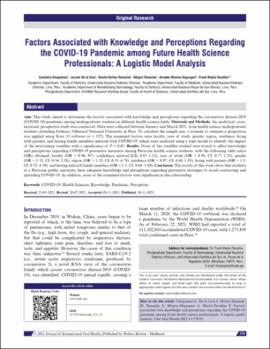
| dc.description.abstract | Aim: This study aimed to determine the factors associated with knowledge and perceptions regarding the coronavirus disease-2019 (COVID-19) pandemic among undergraduate students in different health science fields. Materials and Methods: An analytical, cross-sectional, prospective study was conducted. Data were collected between January and March 2021, from health science undergraduate students attending Federico Villarreal National University in Peru. To calculate the sample size, a formula to estimate a proportion was applied using Stata 15 software (n = 527). The examined factors were faculty, year of study, gender, region, residence, living with parents, and having family members infected with COVID-19, which were analyzed using a logit model to identify the impact of the intervening variables with a significance of P 0.05. Results: None of the variables studied were found to affect knowledge and perceptions regarding COVID-19 preventive measures among Peruvian health science students, with the following odds ratios (OR) obtained: faculty (OR = 0.96; 95% confidence interval [CI]: 0.83-1.12), year of study (OR = 0.98; CI: 0.77-1.25), gender (OR = 1.12; CI: 0.54-2.28), region (OR = 1.32; CI: 0.35-4.78), residence (OR = 0.97; CI: 0.48-1.95), living with parents (OR = 1.5; CI: 0.52-4.39), and having infected family members (OR = 1.5; CI: 0.64-3.49). Conclusion: The results of this study show that students at a Peruvian public university have adequate knowledge and perceptions regarding preventive strategies to avoid contracting and spreading COVID-19. In addition, none of the examined factors were significant in this relationship. | en_US |
| dc.description.sponsorship | This work was partially funded by the Vice‑rectorate of Research of the Universidad Nacional Federico Villarreal to carry out this study con Código RN° 7802‑2020‑CU‑UNFV. | |
| dc.format | application/pdf | |
| dc.language.iso | eng | |
| dc.publisher | Wolters Kluwer Medknow Publications | |
| dc.relation.ispartof | urn:issn:0976-7428 | |
| dc.rights | https://purl.org/coar/access_right/c_abf2 | |
| dc.rights.uri | https://creativecommons.org/licenses/by-nc-sa/4.0/ | |
| dc.subject | SDG 3 | en_US |
| dc.subject | COVID-19, Its Impact, and Vaccination | en_US |
| dc.subject | Knowledge and Attitude Towards COVID-19 Prevention | en_US |
| dc.title | Factors associated with knowledge and perceptions regarding the COVID-19 pandemic among future health science professionals: A logistic model analysis | en_US |
| dc.type | https://purl.org/coar/resource_type/c_dcae04bc | |
| dc.identifier.doi | https://doi.org/10.4103/JIOH.JIOH_121_21 | |
| dc.subject.ocde | https://purl.org/pe-repo/ocde/ford#5.03.01 | |
| dc.type.other | Review | |
| dc.identifier.journal | Journal of International Oral Health | |
| dc.type.version | https://purl.org/coar/version/c_970fb48d4fbd8a85 |
Files in this item
This item appears in the following Collection(s)
-
Artículos de Revisión [256]

Except where otherwise noted, this item's license is described as https://purl.org/coar/access_right/c_abf2