Fluoride release from fluoride varnishes exposed to commonly consumed beverages: An in vitro study
| dc.contributor.author | Casimiro-Iriarte, S.-A. | |
| dc.contributor.author | Chiok-Ocaña, L.-R. | |
| dc.date.accessioned | 2025-10-31T18:45:46Z | |
| dc.date.available | 2025-10-31T18:45:46Z | |
| dc.date.issued | 2023 | |
| dc.identifier.uri | https://hdl.handle.net/20.500.12805/6209 | |
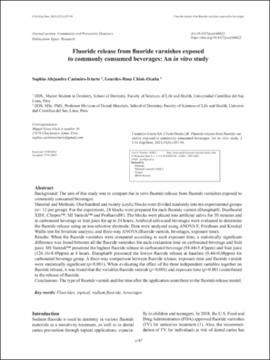
| dc.description.abstract | Background: The aim of this study was to compare the in vitro fluoride release from fluoride varnishes exposed to commonly consumed beverages. Material and Methods: One hundred and twenty acrylic blocks were divided randomly into ten experimental groups (n= 12 per group). For the experiment, 24 blocks were prepared for each fluoride varnish (Duraphat®, Duofluorid XII®, Clinpro™, MI Varnish™ and Profluorid®). The blocks were placed into artificial saliva for 30 minutes and in carbonated beverage or fruit juice for up to 24 hours. Artificial saliva and beverages were evaluated to determine the fluoride release using an ion-selective electrode. Data were analyzed using ANOVA F, Friedman and Kruskal Wallis test for bivariate analysis; and three-way ANOVA (fluoride varnish, beverages, exposure time). Results: When the fluoride varnishes were compared according to each exposure time, a statistically significant difference was found between all the fluoride varnishes for each evaluation time on carbonated beverage and fruit juice. MI Varnish™ presented the highest fluoride release in carbonated beverage (94.44±5.47ppm) and fruit juice (126.16±8.89ppm) at 8 hours. Duraphat® presented the lowest fluoride release at baseline (0.44±0.08ppm) for carbonated beverage group. A three-way comparison between fluoride release, exposure time and fluoride varnish were statistically significant (p<0.001). When evaluating the effect of the three independent variables together on fluoride release, it was found that the variables fluoride varnish (p<0.001) and exposure time (p<0.001) contributed to the release of fluoride. Conclusions: The type of fluoride varnish and the time after the application contribute to the fluoride release model. | en_US |
| dc.description.sponsorship | This research has partial funding from Universidad Científica del Sur (N° 07-DGIDI-CIENTÍFICA-2020). | |
| dc.format | application/pdf | |
| dc.language.iso | eng | |
| dc.publisher | Medicina Oral | |
| dc.relation.ispartof | urn:issn:1989-5488 | |
| dc.rights | https://purl.org/coar/access_right/c_abf2 | |
| dc.rights.uri | https://creativecommons.org/licenses/by-nc-sa/4.0/ | |
| dc.subject | Fluoride and Oral Health in Children | en_US |
| dc.subject | Fluoride and Remineralization in Dental Caries Management | en_US |
| dc.title | Fluoride release from fluoride varnishes exposed to commonly consumed beverages: An in vitro study | en_US |
| dc.type | https://purl.org/coar/resource_type/c_dcae04bc | |
| dc.identifier.doi | https://doi.org/10.4317/jced.60022 | |
| dc.subject.ocde | https://purl.org/pe-repo/ocde/ford#3.02.14 | |
| dc.type.other | Review | |
| dc.identifier.journal | Journal of Clinical and Experimental Dentistry | |
| dc.type.version | https://purl.org/coar/version/c_970fb48d4fbd8a85 |
Files in this item
This item appears in the following Collection(s)
-
Artículos de Revisión [256]

Except where otherwise noted, this item's license is described as https://purl.org/coar/access_right/c_abf2