Elevated Lactate as a Mortality Factor in Poly Traumatised Patients: A Systematic Review and Meta-Analysis
| dc.contributor.author | Carrasco, B.M.G. | |
| dc.contributor.author | Carrasco, O.G. | |
| dc.contributor.author | Gómez, G. | |
| dc.contributor.author | Espinoza-Rojas, R. | |
| dc.contributor.author | Iturregui-Paucar, C.R. | |
| dc.contributor.author | Vásquez-Romero, L.E.M. | |
| dc.contributor.author | Zuzunaga-Montoya, F.E. | |
| dc.contributor.author | Vera-Ponce, V.J. | |
| dc.contributor.author | De La Cruz-Vargas, J.A. | |
| dc.date.accessioned | 2025-10-31T18:45:40Z | |
| dc.date.available | 2025-10-31T18:45:40Z | |
| dc.date.issued | 2023 | |
| dc.identifier.uri | https://hdl.handle.net/20.500.12805/6202 | |
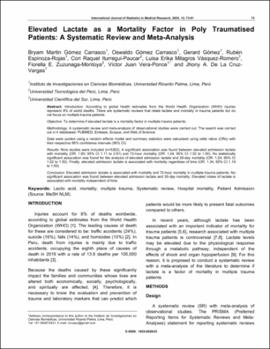
| dc.description.abstract | Introduction: According to global health estimates from the World Health Organization (WHO) injuries represent 8% of world deaths. There are systematic reviews that relate lactate and mortality in trauma patients but do not focus on multiple trauma patients. Objective: To determine if elevated lactate is a mortality factor in multiple trauma patients. Methodology: A systematic review and meta-analysis of observational studies were carried out. The search was carried out in 4 databases: PUBMED, Embase, Scopus, and Web of Science. Data were pooled using a random effects model and summary statistics were calculated using odds ratios (ORs) with their respective 95% confidence intervals (95% CI). Results: Nine studies were included (n=5302). A significant association was found between elevated admission lactate with mortality (OR: 1.80; 95% CI 1.11 to 2.91) and 72-hour mortality (OR: 1.24; 95% CI 1.02 to 1.50). No statistically significant association was found for the analysis of elevated admission lactate and 28-day mortality (OR: 1.24; 95% CI 1.02 to 1.50). Finally, elevated admission lactate is associated with mortality regardless of time (OR: 1.34; 95% CI 1.19 to 1.50). Conclusion: Elevated admission lactate is associated with mortality and 72-hour mortality in multiple trauma patients. No significant association was found between elevated admission lactate and 30-day mortality. Elevated intake of lactate is associated with mortality independent of time. | en_US |
| dc.format | application/pdf | |
| dc.language.iso | eng | |
| dc.publisher | Lifescience Global | |
| dc.relation.ispartof | urn:issn:1929-6029 | |
| dc.rights | https://purl.org/coar/access_right/c_abf2 | |
| dc.rights.uri | https://creativecommons.org/licenses/by-nc-sa/4.0/ | |
| dc.subject | Asthma Management and Quality of Life Enhancements | en_US |
| dc.subject | Lactate Dynamics in Critical Care Outcomes | en_US |
| dc.title | Elevated Lactate as a Mortality Factor in Poly Traumatised Patients: A Systematic Review and Meta-Analysis | en_US |
| dc.type | https://purl.org/coar/resource_type/c_dcae04bc | |
| dc.identifier.doi | https://doi.org/10.6000/1929-6029.2023.12.10 | |
| dc.subject.ocde | https://purl.org/pe-repo/ocde/ford#3.02.08 | |
| dc.type.other | Review | |
| dc.identifier.journal | International Journal of Statistics in Medical Research | |
| dc.type.version | https://purl.org/coar/version/c_970fb48d4fbd8a85 |
Files in this item
This item appears in the following Collection(s)
-
Artículos de Revisión [256]

Except where otherwise noted, this item's license is described as https://purl.org/coar/access_right/c_abf2