Soft skills in personnel training: Report of publications in scopus, topics explored and future research agenda
| dc.contributor.author | Espina-Romero, L.C. | |
| dc.contributor.author | Aguirre Franco, S.L. | |
| dc.contributor.author | Dworaczek Conde, H.O. | |
| dc.contributor.author | Guerrero-Alcedo, J.M. | |
| dc.contributor.author | Ríos Parra, D.E. | |
| dc.contributor.author | Rave Ramírez, J.C. | |
| dc.date.accessioned | 2025-10-31T18:45:15Z | |
| dc.date.available | 2025-10-31T18:45:15Z | |
| dc.date.issued | 2023 | |
| dc.identifier.uri | https://hdl.handle.net/20.500.12805/6175 | |
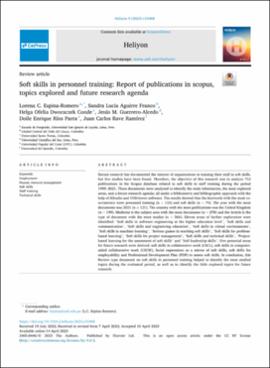
| dc.description.abstract | Recent research has documented the interest of organizations in training their staff in soft skills, but few studies have been found. Therefore, the objective of this research was to analyze 753 publications in the Scopus database related to soft skills in staff training during the period 1999–2021. These documents were analyzed to identify the main information, the most explored areas, and a future research agenda; all under a bibliometric and bibliographic approach with the help of RStudio and VOSviewer software. The results showed that the keywords with the most co-occurrence were personnel training (n = 110) and soft skills (n = 79). The year with the most documents was 2021 (n = 121). The country with the most publications was the United Kingdom (n = 199). Medicine is the subject area with the most documents (n = 278) and the Article is the type of document with the most studies (n = 566). Eleven areas of further exploration were identified: “Soft skills in software engineering at the higher education level”, “Soft skills and communication”, “Soft skills and engineering education”, “Soft skills in virtual environments”, “Soft skills in machine learning”, “Serious games in teaching soft skills”, “Soft skills for problem-based learning”, “Soft skills for project management”, “Soft skills and technical skills”, “Project-based learning for the assessment of soft skills” and “Soft leadership skills”. Five potential areas for future research were derived: soft skills in collaborative work (CSCL), soft skills in computer-aided collaborative work (CSCW), facial expressions as a mirror of soft skills, soft skills for employability and Professional Development Plan (PDP) to assess soft skills. In conclusion, this Review type document on soft skills in personnel training helped to identify the most studied topics during the evaluated period, as well as to identify the little explored topics for future research. | en_US |
| dc.description.sponsorship | The authors thank all the participants, who collaborated selflessly in the study. | |
| dc.format | application/pdf | |
| dc.language.iso | eng | |
| dc.publisher | Elsevier | |
| dc.relation.ispartof | urn:issn:2405-8440 | |
| dc.rights | https://purl.org/coar/access_right/c_abf2 | |
| dc.rights.uri | https://creativecommons.org/licenses/by-nc-sa/4.0/ | |
| dc.subject | SDG 4 | en_US |
| dc.subject | Software Engineering Innovations in Open Source Development | en_US |
| dc.subject | Personality Dynamics in Software Development Teams | en_US |
| dc.title | Soft skills in personnel training: Report of publications in scopus, topics explored and future research agenda | en_US |
| dc.type | https://purl.org/coar/resource_type/c_dcae04bc | |
| dc.identifier.doi | https://doi.org/10.1016/j.heliyon.2023.e15468 | |
| dc.subject.ocde | https://purl.org/pe-repo/ocde/ford#5.02.04 | |
| dc.type.other | Review | |
| dc.identifier.journal | Heliyon | |
| dc.type.version | https://purl.org/coar/version/c_970fb48d4fbd8a85 |
Files in this item
This item appears in the following Collection(s)
-
Artículos de Revisión [256]

Except where otherwise noted, this item's license is described as https://purl.org/coar/access_right/c_abf2