Systematic Review of the Diagnostic Validity of Brief Cognitive Screenings for Early Dementia Detection in Spanish-Speaking Adults in Latin America
| dc.contributor.author | Custodio, N. | |
| dc.contributor.author | Duque, L. | |
| dc.contributor.author | Montesinos, R. | |
| dc.contributor.author | Alva-Diaz, C. | |
| dc.contributor.author | Mellado, M. | |
| dc.contributor.author | Slachevsky, A. | |
| dc.date.accessioned | 2025-10-31T18:44:59Z | |
| dc.date.available | 2025-10-31T18:44:59Z | |
| dc.date.issued | 2020 | |
| dc.identifier.uri | https://hdl.handle.net/20.500.12805/6156 | |
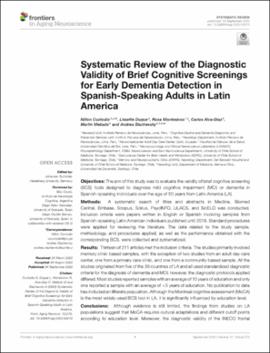
| dc.description.abstract | Objectives: The aim of this study was to evaluate the validity of brief cognitive screening (BCS) tools designed to diagnose mild cognitive impairment (MCI) or dementia in Spanish-speaking individuals over the age of 50 years from Latin America (LA). Methods: A systematic search of titles and abstracts in Medline, Biomed Central, Embase, Scopus, Scirus, PsycINFO, LILACS, and SciELO was conducted. Inclusion criteria were papers written in English or Spanish involving samples from Spanish-speaking Latin American individuals published until 2018. Standard procedures were applied for reviewing the literature. The data related to the study sample, methodology, and procedures applied, as well as the performance obtained with the corresponding BCS, were collected and systematized. Results: Thirteen of 211 articles met the inclusion criteria. The studies primarily involved memory clinic-based samples, with the exception of two studies from an adult day-care center, one from a primary care clinic, and one from a community-based sample. All the studies originated from five of the 20 countries of LA and all used standardized diagnostic criteria for the diagnosis of dementia and MCI; however, the diagnostic protocols applied differed. Most studies reported samples with an average of 10 years of education and only one reported a sample with an average of <5 years of education. No publication to date has included an illiterate population. Although the Montreal cognitive assessment (MoCA) is the most widely-used BCS tool in LA, it is significantly influenced by education level. Conclusions: Although evidence is still limited, the findings from studies on LA populations suggest that MoCA requires cultural adaptations and different cutoff points according to education level. Moreover, the diagnostic validity of the INECO frontal screening (IFS) test should be evaluated in populations with a low level of education. Given the heterogeneity that exists in the levels of education in LA, more studies involving illiterate and indigenous populations are required. | en_US |
| dc.description.sponsorship | Funding. This work was funded by ANID/FONDAP Program Grant 15150012, ANID/FONDEF Grant ID18I10113, and a grant from the Inter-American Development Bank (IADB) (to AS). | |
| dc.format | application/pdf | |
| dc.language.iso | eng | |
| dc.publisher | Frontiers Media | |
| dc.relation.ispartof | urn:issn:1663-4365 | |
| dc.rights | https://purl.org/coar/access_right/c_abf2 | |
| dc.rights.uri | https://creativecommons.org/licenses/by-nc-sa/4.0/ | |
| dc.subject | Cognitive Impairment and Neuroimaging in Alzheimer's Disease | en_US |
| dc.subject | Cognitive Assessment Tools and Traditional Medicine Correlation | en_US |
| dc.title | Systematic Review of the Diagnostic Validity of Brief Cognitive Screenings for Early Dementia Detection in Spanish-Speaking Adults in Latin America | en_US |
| dc.type | https://purl.org/coar/resource_type/c_dcae04bc | |
| dc.identifier.doi | https://doi.org/10.3389/fnagi.2020.00270 | |
| dc.subject.ocde | https://purl.org/pe-repo/ocde/ford#5.03.00 | |
| dc.type.other | Review | |
| dc.identifier.journal | Frontiers in Aging Neuroscience | |
| dc.type.version | https://purl.org/coar/version/c_970fb48d4fbd8a85 |
Files in this item
This item appears in the following Collection(s)
-
Artículos de Revisión [256]

Except where otherwise noted, this item's license is described as https://purl.org/coar/access_right/c_abf2