Health system responses for type 1 diabetes: A scoping review
| dc.contributor.author | Zafra-Tanaka, J.H. | |
| dc.contributor.author | Beran, D. | |
| dc.contributor.author | Bernabe-Ortiz, A. | |
| dc.date.accessioned | 2025-10-31T18:44:49Z | |
| dc.date.available | 2025-10-31T18:44:49Z | |
| dc.date.issued | 2022 | |
| dc.identifier.uri | https://hdl.handle.net/20.500.12805/6145 | |
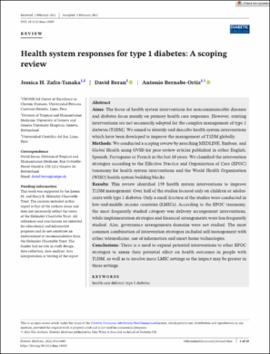
| dc.description.abstract | Aims: The focus of health system interventions for noncommunicable diseases and diabetes focus mainly on primary health care responses. However, existing interventions are not necessarily adapted for the complex management of type 1 diabetes (T1DM). We aimed to identify and describe health system interventions which have been developed to improve the management of T1DM globally. Methods: We conducted a scoping review by searching MEDLINE, Embase, and Global Health using OVID for peer-review articles published in either English, Spanish, Portuguese or French in the last 10 years. We classified the intervention strategies according to the Effective Practice and Organization of Care (EPOC) taxonomy for health system interventions and the World Health Organization (WHO) health system building blocks. Results: This review identified 159 health system interventions to improve T1DM management. Over half of the studies focused only on children or adolescents with type 1 diabetes. Only a small fraction of the studies were conducted in low-and-middle income countries (LMICs). According to the EPOC taxonomy, the most frequently studied category was delivery arrangement interventions, while implementation strategies and financial arrangements were less frequently studied. Also, governance arrangements domains were not studied. The most common combination of intervention strategies included self-management with either telemedicine, use of information and smart home technologies. Conclusions: There is a need to expand potential interventions to other EPOC strategies to assess their potential effect on health outcomes in people with T1DM, as well as to involve more LMIC settings as the impact may be greater in these settings. | en_US |
| dc.description.sponsorship | This work was supported by the Leona M. and Harry B. Helmsley Charitable Trust. The analysis included in this report is that of the authors alone and does not necessarily reflect the views of the Helmsley Charitable Trust. All references and conclusions are intended for educational and informative purposes and do not constitute an endorsement or recommendation from the Helmsley Charitable Trust. The funder had no role in study design, data collection, data analysis, data interpretation or writing of the report. | |
| dc.format | application/pdf | |
| dc.language.iso | eng | |
| dc.publisher | John Wiley and Sons | |
| dc.relation.ispartof | urn:issn:1464-5491 | |
| dc.rights | https://purl.org/coar/access_right/c_abf2 | |
| dc.rights.uri | https://creativecommons.org/licenses/by-nc-sa/4.0/ | |
| dc.subject | SDG 3 | en_US |
| dc.subject | Quality of Life for Children with Health Needs | en_US |
| dc.subject | Family Dynamics in Adolescent Diabetes Management | en_US |
| dc.title | Health system responses for type 1 diabetes: A scoping review | en_US |
| dc.type | https://purl.org/coar/resource_type/c_dcae04bc | |
| dc.identifier.doi | https://doi.org/10.1111/dme.14805 | |
| dc.subject.ocde | https://purl.org/pe-repo/ocde/ford#3.02.18 | |
| dc.type.other | Review | |
| dc.identifier.journal | Diabetic Medicine | |
| dc.type.version | https://purl.org/coar/version/c_970fb48d4fbd8a85 |
Files in this item
This item appears in the following Collection(s)
-
Artículos de Revisión [256]

Except where otherwise noted, this item's license is described as https://purl.org/coar/access_right/c_abf2