Monkeypox-Associated Manifestations and Complications Involving the Eye: A Systematic Review and Meta-Analysis of Previous and Current Outbreaks
| dc.contributor.author | Abdelaal, A. | |
| dc.contributor.author | Reda, A. | |
| dc.contributor.author | Hassan, A.R. | |
| dc.contributor.author | Mashaal, A. | |
| dc.contributor.author | Abu Serhan, H. | |
| dc.contributor.author | Katamesh, B.E. | |
| dc.contributor.author | Abdelazeem, B. | |
| dc.contributor.author | Mohanty, A. | |
| dc.contributor.author | Padhi, B.K. | |
| dc.contributor.author | Rodriguez-Morales, A.J. | |
| dc.contributor.author | Sah, R. | |
| dc.date.accessioned | 2025-10-31T18:44:28Z | |
| dc.date.available | 2025-10-31T18:44:28Z | |
| dc.date.issued | 2023 | |
| dc.identifier.uri | https://hdl.handle.net/20.500.12805/6121 | |
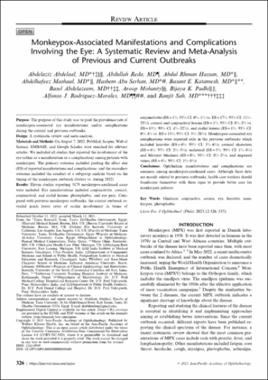
| dc.description.abstract | Purpose: The purpose of this study was to pool the prevalence rate of monkeypox-Associated eye manifestations and/or complications during the current and previous outbreaks. Design: A systematic review and meta-Analysis. Materials and Methods: On August 7, 2022, PubMed, Scopus, Web of Science, EMBASE, and Google Scholar were searched for relevant articles. We included all studies that reported the involvement of the eye (either as a manifestation or a complication) among patients with monkeypox. The primary outcome included pooling the effect size (ES) of reported manifestations and complications, and the secondary outcome included the conduct of a subgroup analysis based on the timing of the monkeypox outbreak (before vs. during 2022). Results: Eleven studies reporting 3179 monkeypox-confirmed cases were included. Eye manifestations included conjunctivitis, corneal, conjunctival, and eyelid lesions, photophobia, and eye pain. Compared with previous monkeypox outbreaks, the current outbreak revealed much lower rates of ocular involvement in terms of conjunctivitis (ES=1%; 95% CI: 0%-1% vs. ES=17%; 95% CI: 11%-22%), corneal and conjunctival lesions (ES=1%; 95% CI: 0%-2% vs. ES=13%; 95% CI: 4%-22%), and eyelid lesions (ES=1%; 95% CI: 0%-4% vs. ES=13%; 95% CI: 5%-28%). Monkeypox-Associated eye complications were reported only in the previous outbreaks which included keratitis (ES=4%; 95% CI: 3%-6%), corneal ulceration (ES=4%; 95% CI: 2%-5%), unilateral (ES=3%; 95% CI: 1%-4%) and bilateral blindness (ES=0%; 95% CI: 0%-2%), and impaired vision (ES=4%; 95% CI: 1%-8%). Conclusions: Ophthalmic manifestations and complications are common among monkeypox-confirmed cases. Although these data are mainly related to previous outbreaks, health care workers should familiarize themselves with these signs to provide better care for monkeypox patients. | en_US |
| dc.format | application/pdf | |
| dc.language.iso | eng | |
| dc.publisher | Lippincott Williams and Wilkins | |
| dc.relation.ispartof | urn:issn:2162-0989 | |
| dc.rights | https://purl.org/coar/access_right/c_abf2 | |
| dc.rights.uri | https://creativecommons.org/licenses/by-nc-sa/4.0/ | |
| dc.subject | Vaccination Strategies Against Emerging Viral Threats | en_US |
| dc.subject | Monkeypox Virus Dynamics and Public Health Response | en_US |
| dc.title | Monkeypox-Associated Manifestations and Complications Involving the Eye: A Systematic Review and Meta-Analysis of Previous and Current Outbreaks | en_US |
| dc.type | https://purl.org/coar/resource_type/c_dcae04bc | |
| dc.identifier.doi | https://doi.org/10.1097/APO.0000000000000608 | |
| dc.subject.ocde | https://purl.org/pe-repo/ocde/ford#3.02.22 | |
| dc.type.other | Review | |
| dc.identifier.journal | Asia-Pacific Journal of Ophthalmology | |
| dc.type.version | https://purl.org/coar/version/c_970fb48d4fbd8a85 |
Files in this item
This item appears in the following Collection(s)
-
Artículos de Revisión [256]

Except where otherwise noted, this item's license is described as https://purl.org/coar/access_right/c_abf2