Estudios históricos y sociales sobre el trauma colectivo. Revisitando los efectos de la violencia política en contextos latinoamericanos
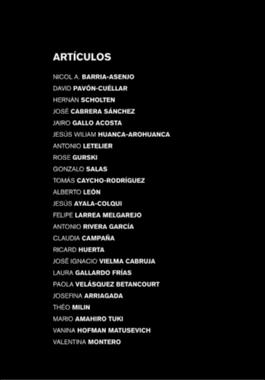
| dc.contributor.author | Barria-Asenjo, N.A. | |
| dc.contributor.author | Pavón-Cuéllar, D. | |
| dc.contributor.author | Scholten, H. | |
| dc.contributor.author | Sánchez, J.C. | |
| dc.contributor.author | Acosta, J.G. | |
| dc.contributor.author | Huanca-Arohuanca, J.W. | |
| dc.contributor.author | Letelier, S.A. | |
| dc.contributor.author | Gurski, R. | |
| dc.contributor.author | Salas, G. | |
| dc.contributor.author | Caycho-Rodríguez, T. | |
| dc.contributor.author | León, A. | |
| dc.contributor.author | Ayala-Colqui, J. | |
| dc.date.accessioned | 2025-10-31T18:44:18Z | |
| dc.date.available | 2025-10-31T18:44:18Z | |
| dc.date.issued | 2023 | |
| dc.identifier.uri | https://hdl.handle.net/20.500.12805/6109 | |
| dc.description.abstract | This research paper explores the concept of collective trauma and its application in the historical and social context of Latin American societies. The transfer of the term «collective trauma» from the field of psychological knowledge to the social and historical sphere raises questions about its legitimacy and conceptual framework. The study examines the fidelity of this conceptual transfer and its relationship with the early psychoanalytic understanding of traumatic phenomena. The European cultural context of the late 19th and early 20th centuries provided the basis for theorizing the consequences of intense and violent experiences, resulting in the concept of «traumatic neurosis», influenced significantly by Freud's work. The article discusses the appropriation of psychoanalytic tools in historical and cultural criticism to comprehend events that challenge traditional frameworks and social intelligibility, such as the Holocaust. The notion of trauma as an enigmatic and recurrent force in historical experience is explored through the lens of trauma studies. The article highlights prominent scholars in this field and their use of psychoanalytic concepts, demonstrating the preservation and meaningful application of these concepts in understanding historical and collective phenomena. By bridging the gap between individual psychological experiences and collective traumas, trauma studies offer a unique approach to interpreting and representing events that resist traditional historical narratives. | en_US |
| dc.description.abstract | Este artículo explora el concepto de trauma colectivo y su aplicación en el contexto histórico y social de las sociedades latinoamericanas. La transferencia del término «trauma colectivo» desde el campo del conocimiento psicológico a la esfera social e histórica plantea preguntas sobre su legitimidad y marco conceptual. El estudio examina la fidelidad de esta transferen-cia conceptual y su relación con la comprensión psicoanalítica temprana de los fenómenos traumáticos. El contexto cultural europeo de finales del siglo xix y principios del siglo xxproporcionó la base para teorizar las consecuencias de experiencias intensas y violentas, lo que resultó en el concepto de «neurosis traumática», influenciado significativamente por el trabajo de Freud. El artículo discute la apropiación de herramientas psicoanalíticas en la crítica histórica y cultural para comprender eventos que desafían marcos tradicionales y la inteligibilidad social, como el Holocausto. La noción del trauma como una fuerza enigmática y recurrente en la experiencia histórica se explora a través del enfoque de los estudios del trauma. El artículo pone de relieve a destacados y destacadas académicas en este campo y su uso de conceptos psicoanalíticos, demostrando la preservación y aplicación significativa de estas nociones en la comprensión de fenómenos históricos y colectivos. Al acortar la brecha entre las experiencias psicológicas individuales y los traumas colectivos, los estudios del trauma ofrecen un enfoque único para interpretar y representar eventos que resisten las narrativas históricas tradicionales. | es_PE |
| dc.format | application/pdf | |
| dc.language.iso | spa | |
| dc.publisher | Pontificia Universidad Católica de Chile | |
| dc.relation.ispartof | urn:issn:0718-7181 | |
| dc.rights | https://purl.org/coar/access_right/c_abf2 | |
| dc.rights.uri | https://creativecommons.org/licenses/by-nc-sa/4.0/ | |
| dc.subject | SDG 16 | en_US |
| dc.subject | Opioid Use and Management in Healthcare | en_US |
| dc.subject | Opioid Crisis Management and Public Health Strategies | en_US |
| dc.title | Estudios históricos y sociales sobre el trauma colectivo. Revisitando los efectos de la violencia política en contextos latinoamericanos | es_PE |
| dc.title.alternative | Historical and Social Studies on Collective Trauma. Revisiting the Effects of Political Violence in Latin American Contexts | en_US |
| dc.type | https://purl.org/coar/resource_type/c_dcae04bc | |
| dc.identifier.doi | https://doi.org/10.7764/Aisth.74.9 | |
| dc.subject.ocde | https://purl.org/pe-repo/ocde/ford#6.01.00 | |
| dc.type.other | Review | |
| dc.identifier.journal | Aisthesis | |
| dc.type.version | https://purl.org/coar/version/c_970fb48d4fbd8a85 |
Files in this item
This item appears in the following Collection(s)
-
Artículos de Revisión [256]

Except where otherwise noted, this item's license is described as https://purl.org/coar/access_right/c_abf2