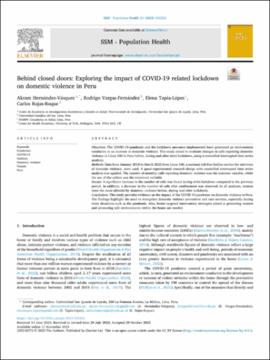
Behind closed doors: Exploring the impact of COVID-19 related lockdown on domestic violence in Peru
| dc.contributor.author | Hernández-Vásquez, A. | |
| dc.contributor.author | Vargas-Fernández, R. | |
| dc.contributor.author | Tapia-López, E. | |
| dc.contributor.author | Rojas-Roque, C. | |
| dc.date.accessioned | 2025-10-31T18:44:08Z | |
| dc.date.available | 2025-10-31T18:44:08Z | |
| dc.date.issued | 2023 | |
| dc.identifier.uri | https://hdl.handle.net/20.500.12805/6097 | |
| dc.description.abstract | Objectives: The COVID-19 pandemic and the lockdown measures implemented have generated an environment conducive to an increase in domestic violence. This study aimed to evaluate changes in calls reporting domestic violence to Línea 100 in Peru before, during and after strict lockdown, using a controlled interrupted time series analysis. Methods: Data from January 2018 to March 2022 from Línea 100, a national toll-free hotline service for survivors of domestic violence, were used. A quasi-experimental research design with controlled interrupted time series analysis was applied. The number of monthly calls reporting domestic violence was the outcome variable, while the sex of the callers was the treatment variable. Results: A significant increase in the number of calls was found during strict lockdown compared to the previous period. In addition, a decrease in the number of calls after confinement was observed. In all analyses, women were the most affected by domestic violence before, during and after lockdown. Conclusions: This study provides evidence on the impact of the COVID-19 pandemic on domestic violence in Peru. The findings highlight the need to strengthen domestic violence prevention and care services, especially during crisis situations such as the pandemic. Also, better targeted intervention strategies aimed at protecting women and promoting safe environments within the home are needed. | en_US |
| dc.description.sponsorship | The COVID-19 pandemic created a period of great uncertainty, which, in turn, generated an environment conducive to the development or increase of violent attitudes within the home through the preventive measures taken by 190 countries to control the spread of the disease (Phillips et al., 2021). Specifically, one of the measures that directly and indirectly influenced this socio-health problem is lockdown (which includes an stay-at-home order), which led to survivors of violence being isolated in the same home as their perpetrators (Lyons & Brewer, 2022). In fact, a systematic review (SR) that included data from 28 studies conducted in the Asia (n = 9 studies), North America (n = 13), Middle East (n = 2), Europe (n = 3) and Africa (n = 1) regions reported that the consequences of lockdown allowed perpetrators to exert more violence on their survivors due to economic dependence on the partner and increased stress (due to an increased unemployment rate, school and business closures) and alcohol consumption, control and isolation of the survivors due to lack of support networks, and underreporting of violence events in the homes (Letourneau et al., 2022). All these triggers in various regions of the world generated an increase in the prevalence of domestic violence (in all its forms) and its severity in various regions of the world (Peitzmeier et al., 2022; Thiel et al., 2022), with even new cases of domestic violence being reported with the initiation of preventive measures by COVID-19, as described in the biomedical literature.The authors thank the Universidad Científica del Sur for their support in the publication of this research as well as Donna Pringle for reviewing the language and style. | |
| dc.format | application/pdf | |
| dc.language.iso | eng | |
| dc.publisher | Elsevier | |
| dc.relation.ispartof | urn:issn:2352-8273 | |
| dc.rights | https://purl.org/coar/access_right/c_abf2 | |
| dc.rights.uri | https://creativecommons.org/licenses/by-nc-sa/4.0/ | |
| dc.subject | SDG 5 | en_US |
| dc.subject | SDG 16 | en_US |
| dc.subject | Intimate Partner Violence and Its Impacts | en_US |
| dc.subject | COVID-19 Impact on Domestic Violence and Crime | en_US |
| dc.title | Behind closed doors: Exploring the impact of COVID-19 related lockdown on domestic violence in Peru | en_US |
| dc.type | https://purl.org/coar/resource_type/c_2df8fbb1 | |
| dc.identifier.doi | https://doi.org/10.1016/j.ssmph.2023.101552 | |
| dc.subject.ocde | https://purl.org/pe-repo/ocde/ford#5.04.01 | |
| dc.type.other | Research article | |
| dc.identifier.journal | SSM - Population Health | |
| dc.type.version | https://purl.org/coar/version/c_970fb48d4fbd8a85 |
Files in this item
This item appears in the following Collection(s)
-
Artículos de Investigación [1294]

Except where otherwise noted, this item's license is described as https://purl.org/coar/access_right/c_abf2