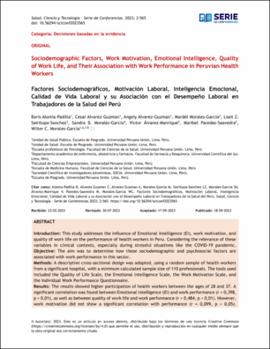
Sociodemographic Factors, Work Motivation, Emotional Intelligence, Quality of Work Life, and Their Association with Work Performance in Peruvian Health Workers
| dc.contributor.author | Alomia-Padilla, B. | |
| dc.contributor.author | Alvarez-Guzman, C. | |
| dc.contributor.author | Alvarez-Guzman, A. | |
| dc.contributor.author | Morales-García, M. | |
| dc.contributor.author | Sairitupa-Sanchez, L.Z. | |
| dc.contributor.author | Morales-García, S.B. | |
| dc.contributor.author | Álvarez-Manrique, V. | |
| dc.contributor.author | Paredes-Saavedra, M. | |
| dc.contributor.author | Morales-García, W.C. | |
| dc.date.accessioned | 2025-10-31T18:44:06Z | |
| dc.date.available | 2025-10-31T18:44:06Z | |
| dc.date.issued | 2023 | |
| dc.identifier.uri | https://hdl.handle.net/20.500.12805/6095 | |
| dc.description.abstract | Introduction: This study addresses the influence of Emotional Intelligence (EI), work motivation, and quality of work life on the performance of health workers in Peru. Considering the relevance of these variables in clinical contexts, especially during stressful situations like the COVID-19 pandemic. Objective: The aim was to determine how these sociodemographic and psychosocial factors are associated with work performance in this sector. Methods: A descriptive cross-sectional design was adopted, using a random sample of health workers from a significant hospital, with a minimum calculated sample size of 110 professionals. The tools used included the Quality of Life Scale, the Emotional Intelligence Scale, the Work Motivation Scale, and the Individual Work Performance Questionnaire. Results: The results showed higher participation of health workers between the ages of 28 and 37. A significant correlation was found between Emotional Intelligence (EI) and work performance (r = 0,398, p < 0,01), as well as between quality of work life and work performance (r = 0,484, p < 0,01). However, work motivation did not show a significant correlation with performance (r = 0,099, p > 0,05). Additionally, the variables of being female and working in the care area were significantly related to better work performance. Conclusion: The study concludes that work performance in the health sector is positively influenced by Emotional Intelligence and quality of work life. These findings highlight the importance of emotional support, cooperation, and communication in health environments, as well as recognition through non-monetary incentives. This comprehensive approach may be key to improving productivity and the quality of patient care in health facilities. | en_US |
| dc.format | application/pdf | |
| dc.language.iso | eng | |
| dc.publisher | Editorial Salud, Ciencia y Tecnología | |
| dc.relation.ispartof | urn:issn:2953-4860 | |
| dc.rights | https://purl.org/coar/access_right/c_abf2 | |
| dc.rights.uri | https://creativecommons.org/licenses/by-nc-sa/4.0/ | |
| dc.subject | Emotional Intelligence and Career Adaptability Insights | en_US |
| dc.subject | Emotional Intelligence and Its Impact on Performance | en_US |
| dc.title | Sociodemographic Factors, Work Motivation, Emotional Intelligence, Quality of Work Life, and Their Association with Work Performance in Peruvian Health Workers | en_US |
| dc.type | https://purl.org/coar/resource_type/c_2df8fbb1 | |
| dc.identifier.doi | https://doi.org/10.56294/sctconf2023565 | |
| dc.subject.ocde | https://purl.org/pe-repo/ocde/ford#5.02.04 | |
| dc.type.other | Research article | |
| dc.identifier.journal | Salud, Ciencia y Tecnologia - Serie de Conferencias | |
| dc.type.version | https://purl.org/coar/version/c_970fb48d4fbd8a85 |
Files in this item
This item appears in the following Collection(s)
-
Artículos de Investigación [1294]

Except where otherwise noted, this item's license is described as https://purl.org/coar/access_right/c_abf2