Influencia del Estrés Crónico y de la Masticación Sobre el Dolor.
| dc.contributor.author | Aguirre-Siancas, E. | |
| dc.contributor.author | Seclén-Ubillús, Y. | |
| dc.contributor.author | Ruiz-Ramírez, E. | |
| dc.contributor.author | Portilla-Flores, O. | |
| dc.contributor.author | Crispín-Huamani, L. | |
| dc.contributor.author | Alarcón-Velásquez, L. | |
| dc.contributor.author | Lam-Figueroa, N. | |
| dc.date.accessioned | 2025-10-31T18:43:56Z | |
| dc.date.available | 2025-10-31T18:43:56Z | |
| dc.date.issued | 2019 | |
| dc.identifier.uri | https://revecuatneurol.com/magazine_issue_article/influencia-estres-cronico-masticacion-sobre-dolor-influence-chronic-stress-chewing-over-pain/ | |
| dc.identifier.uri | https://hdl.handle.net/20.500.12805/6083 | |
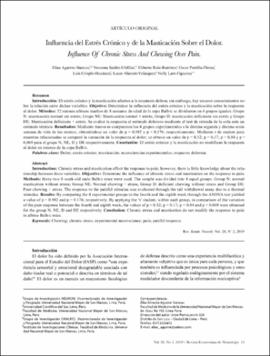
| dc.description.abstract | Introduction: Chronic stress and mastication affect the response to pain; however, there is little knowledge about the relationship between these variables. Objective: Determine the influence of chronic stress and mastication on the response to pain. Methods: thirty-two 8-week-old male Balb/c mice were used. The sample was divided into 4 equal groups: Group N: normal mastication without stress; Group NE: Normal chewing + stress, Group D: deficient chewing without stress and Group DE: Poor chewing + stress. The response to the painful stimulus was evaluated through the tail withdrawal assay due to a thermal stimulus. Results: By comparing the 4 experimental groups to the fourth and the eighth week through the ANOVA test yielded a value of p = 0.982 and p = 0.176; respectively. By applying the ‘t’ student, within each group, in comparison of the variation of the pain response between the fourth and eighth week, the values of p = 0.52; p = 0.17; p = 0.84 and p = 0.069 were obtained for the group N, NE, D and DE respectively. Conclusion: Chronic stress and mastication do not modify the response to pain in albino Balb/c mice. | en_US |
| dc.description.abstract | Introducción: El estrés crónico y la masticación afectan a la respuesta dolora; sin embargo, hay escasos conocimientos sobre la relación entre dichas variables. Objetivo: Determinar la influencia del estrés crónico y la masticación sobre la respuesta al dolor. Métodos: 32 ratones albinos machos de 8 semanas de edad de la cepa Balb/c se dividieron en 4 grupos iguales: Grupo N: masticación normal sin estrés; Grupo NE: Masticación normal + estrés, Grupo D: masticación deficiente sin estrés y Grupo DE: Masticación deficiente + estrés. Se evaluó la respuesta al estímulo doloroso mediante el test de retirada de la cola ante un estímulo térmico. Resultados: Mediante Anova se compararon los 4 grupos experimentales a la décima segunda y décima sexta semana de vida de los ratones, obteniéndose un valor de p = 0,982 y p = 0,176; respectivamente. Mediante t de student para muestras relacionadas se comparó la variación de la respuesta al dolor; se obtuvo un valor de p = 0,52; p = 0,17; p = 0,84 y p = 0,069 para el grupo N, NE, D y DE respectivamente. Conclusión: El estrés crónico y la masticación no modifican la respuesta al dolor en ratones de la cepa Balb/c. | es_PE |
| dc.format | application/pdf | |
| dc.language.iso | spa | |
| dc.publisher | Fundación para la Difusion Neurológica en Ecuador | |
| dc.relation.ispartof | urn:issn:1019-8113 | |
| dc.rights | https://purl.org/coar/access_right/c_abf2 | |
| dc.rights.uri | https://creativecommons.org/licenses/by-nc-sa/4.0/ | |
| dc.subject | Implant Innovations in Orthodontics and Bone Health | en_US |
| dc.subject | Cognitive Impact of Masticatory Function and Tooth Loss | en_US |
| dc.title | Influencia del Estrés Crónico y de la Masticación Sobre el Dolor. | es_PE |
| dc.title.alternative | Influence of chronic stress and chewing over pain. | en_US |
| dc.type | https://purl.org/coar/resource_type/c_2df8fbb1 | |
| dc.subject.ocde | https://purl.org/pe-repo/ocde/ford#3.02.25 | |
| dc.type.other | Research article | |
| dc.identifier.journal | Revista Ecuatoriana de Neurologia | |
| dc.type.version | https://purl.org/coar/version/c_970fb48d4fbd8a85 |
Files in this item
This item appears in the following Collection(s)
-
Artículos de Investigación [1294]

Except where otherwise noted, this item's license is described as https://purl.org/coar/access_right/c_abf2