Carbono en el Pacífico sudamericano: reservas en comunidades vegetales de un humedal costero en Perú
| dc.contributor.author | Chavez, R. | |
| dc.contributor.author | Aponte, H. | |
| dc.date.accessioned | 2025-10-31T18:43:46Z | |
| dc.date.available | 2025-10-31T18:43:46Z | |
| dc.date.issued | 2023 | |
| dc.identifier.uri | https://hdl.handle.net/20.500.12805/6071 | |
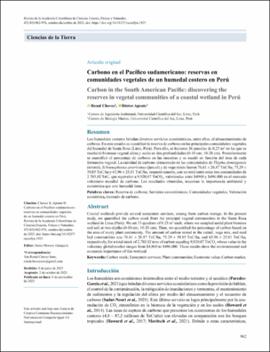
| dc.description.abstract | Coastal wetlands provide several ecosystem services, among them carbon storage. In the present study, we quantified the carbon stock from the principal vegetal communities in the Santa Rosa wetland in Lima (Perú). We set 33 quadrats of 0.25 m2 each, where we sampled aerial plant biomass and soil at two depths (0-10 cm; 10-20 cm). Then, we quantified the percentage of carbon based on the area of every plant community. The amount of carbon stored in the cattail, vega mix, and reed bed communities was 76.61 ± 26.87 TnC/ha, 75.29 ± 39.85 TnC/ha, and 63.96 ± 25.81 TnC/ha, respectively, for a total stock of 2,703.02 tons of carbon equaling 9,920.07 TnCO<inf>2</inf> whose value in the voluntary global market ranges from $4,960 to $496,000. These results show the environmental and economic importance of this wetland. | en_US |
| dc.description.abstract | Los humedales costeros brindan diversos servicios ecosistémicos, entre ellos, el almacenamiento de carbono. En este estudio se cuantificó la reserva de carbono en las principales comunidades vegetales del humedal de Santa Rosa (Lima, Perú). Para ello, se hicieron 36 parcelas de 0,25 m2 en las que se recolectó biomasa vegetal aérea y suelo en dos profundidades (0-10 cm; 10-20 cm). Posteriormente se cuantificó el porcentaje de carbono en las muestras y se escaló en función del área de cada formación vegetal. La cantidad de carbono almacenado en las comunidades de Thypha domingensis (totoral), Schoenoplectus americanus (juncal) y de vega mixta fueron 76,61 ± 26,87 TnC/ha, 75,29 ± 39,85 TnC/ha y 63,96 ± 25,81 TnC/ha, respectivamente, con un total entre estas tres comunidades de 2.703,02 TnC, que equivalen a 9,920,07 TnCO2, valorizadas entre $4960 y $496.000 en el mercado voluntario mundial de carbono. Los resultados obtenidos, muestran la importancia ambiental y económica que este humedal tiene. | es_PE |
| dc.format | application/pdf | |
| dc.language.iso | spa | |
| dc.publisher | Colombian Academy of Exact, Physical and Natural Sciences | |
| dc.relation.ispartof | urn:issn:0370-3908 | |
| dc.rights | https://purl.org/coar/access_right/c_abf2 | |
| dc.rights.uri | https://creativecommons.org/licenses/by-nc-sa/4.0/ | |
| dc.subject | Mangrove Ecosystems and Heavy Metal Pollution Dynamics | en_US |
| dc.subject | Mangrove Ecosystems and Carbon Sequestration Potential | en_US |
| dc.title | Carbono en el Pacífico sudamericano: reservas en comunidades vegetales de un humedal costero en Perú | es_PE |
| dc.title.alternative | Carbon in the South American Pacific: discovering the reserves in vegetal communities of a coastal wetland in Perú | en_US |
| dc.type | https://purl.org/coar/resource_type/c_2df8fbb1 | |
| dc.identifier.doi | https://doi.org/10.18257/raccefyn.1925 | |
| dc.subject.ocde | https://purl.org/pe-repo/ocde/ford#1.06.00 | |
| dc.type.other | Research article | |
| dc.identifier.journal | Revista de la Academia Colombiana de Ciencias Exactas, Fisicas y Naturales | |
| dc.type.version | https://purl.org/coar/version/c_970fb48d4fbd8a85 |
Files in this item
This item appears in the following Collection(s)
-
Artículos de Investigación [1294]

Except where otherwise noted, this item's license is described as https://purl.org/coar/access_right/c_abf2