¿Se están reduciendo los humedales de la costa del Pacífico suramericano? El caso de los humedales de Lima
| dc.contributor.author | Urbina, D. | |
| dc.contributor.author | Rivera-Cáceda, F. | |
| dc.contributor.author | Aponte, H. | |
| dc.date.accessioned | 2025-10-31T18:43:46Z | |
| dc.date.available | 2025-10-31T18:43:46Z | |
| dc.date.issued | 2022 | |
| dc.identifier.uri | https://hdl.handle.net/20.500.12805/6070 | |
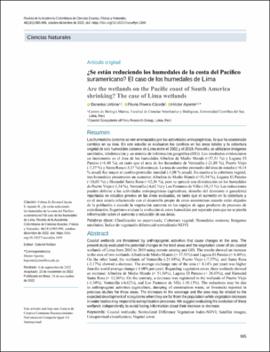
| dc.description.abstract | Coastal wetlands are threatened by anthropogenic activities that cause changes in the area. The present study evaluated the potential changes in the total areas and the vegetation cover of six coastal wetlands of Lima from 2002 to 2019 using remote sensing and GIS. The results showed an increase in the area of two wetlands: Albufera de Medio Mundo (+ 37.51%) and Laguna El Paraíso (+ 6.40%). On the other hand, the wetlands of Ventanilla (-21.88%), Puerto Viejo (-7.37%), and Santa Rosa (-3.17%) showed a decrease. The average exchange rate of the area (+ 0.14% per year) was higher than the world average change (-1.08% per year). Regarding vegetation cover, three wetlands showed an increase: Albufera de Medio Mundo (+ 51.54%), Laguna El Paraiso (+ 26.03%), and Humedal Santa Rosa (+ 12.36%). On the contrary, a decrease was registered in the wetlands of Puerto Viejo (-1.34%), Ventanilla (-6.62%), and Los Pantanos de Villa (-18.13%). The reductions may be due to anthropogenic activities (agriculture, dumping of construction waste, or livestock) reported in previous studies for these areas. The increases in the coverage and the area may be related to the expected development of ecosystems when they are far from the population while vegetation increases in water bodies may respond to eutrophication processes. We suggest evaluating the evolution of these wetlands independently to avoid losing information about their increase or decrease. | en_US |
| dc.description.abstract | Los humedales costeros se ven amenazados por las actividades antropogénicas, lo que ha ocasionado cambios en su área. En este estudio se evaluaron los cambios en las áreas totales y la cobertura vegetal de seis humedales costeros de Lima entre el 2002 y el 2019. Para ello, se utilizaron imágenes satelitales, teledetección y un sistema de información geográfica (SIG). Los resultados evidenciaron un incremento en el área de los humedales Albufera de Medio Mundo (+37,51 %) y Laguna El Paraíso (+6,40 %), en tanto que el área de los humedales de Ventanilla (-21,88 %), Puerto Viejo (-7,37 %) y Santa Rosa (-3,17 %) disminuyó. La tasa de cambio promedio del área de estudio (+0,14 % anual) fue mayor al cambio promedio mundial (-1,08 % anual). En cuanto a la cobertura vegetal, tres humedales presentaron un aumento: Albufera de Medio Mundo (+51,54 %), Laguna El Paraíso (+26,03 %) y Humedal Santa Rosa (+12,36 %), pero se apreció una disminución en los humedales de Puerto Viejo (-1,34 %), Ventanilla (-6,62 %) y Los Pantanos de Villa (-18,13 %). Las reducciones pueden deberse a las actividades antropogénicas (agricultura, desecho del desmonte o ganadería) reportadas en estudios previos en las áreas evaluadas, en tanto que el aumento en la cobertura y en el área estaría relacionado con el desarrollo propio de estos ecosistemas cuando están alejados de la población o cuando la vegetación aumenta en los espejos de agua producto de procesos de eutrofización. Sugerimos evaluar la evolución de estos humedales por separado para que no se pierda información sobre el aumento o reducción de sus áreas. | es_PE |
| dc.format | application/pdf | |
| dc.language.iso | spa | |
| dc.publisher | Colombian Academy of Exact, Physical and Natural Sciences | |
| dc.relation.ispartof | urn:issn:0370-3908 | |
| dc.rights | https://purl.org/coar/access_right/c_abf2 | |
| dc.rights.uri | https://creativecommons.org/licenses/by-nc-sa/4.0/ | |
| dc.subject | SDG 14 | en_US |
| dc.subject | Marine Ecosystems and Plastic Waste Management | en_US |
| dc.subject | Wetland Conservation and Biodiversity in Peru | en_US |
| dc.title | ¿Se están reduciendo los humedales de la costa del Pacífico suramericano? El caso de los humedales de Lima | es_PE |
| dc.title.alternative | Are the wetlands on the Pacific coast of South America shrinking? The case of Lima wetlands | en_US |
| dc.type | https://purl.org/coar/resource_type/c_2df8fbb1 | |
| dc.identifier.doi | https://doi.org/10.18257/raccefyn.1699 | |
| dc.subject.ocde | https://purl.org/pe-repo/ocde/ford#1.05.00 | |
| dc.type.other | Research article | |
| dc.identifier.journal | Revista de la Academia Colombiana de Ciencias Exactas, Fisicas y Naturales | |
| dc.type.version | https://purl.org/coar/version/c_970fb48d4fbd8a85 |
Files in this item
This item appears in the following Collection(s)
-
Artículos de Investigación [1294]

Except where otherwise noted, this item's license is described as https://purl.org/coar/access_right/c_abf2