Seroprevalencia de hepatitis B en población adulta de un distrito de Cajamarca
| dc.contributor.author | Albán Fernández, L. | |
| dc.contributor.author | Albán Olaya, M. | |
| dc.contributor.author | López Chegne, N. | |
| dc.contributor.author | Rabanal Becerra, D. | |
| dc.contributor.author | Araujo Salazar, V. | |
| dc.contributor.author | Cabrera Huamán, K. | |
| dc.date.accessioned | 2025-10-31T18:43:31Z | |
| dc.date.available | 2025-10-31T18:43:31Z | |
| dc.date.issued | 2021 | |
| dc.identifier.uri | http://www.scielo.org.pe/scielo.php?script=sci_arttext&pid=S1022-51292021000100016 | |
| dc.identifier.uri | https://hdl.handle.net/20.500.12805/6051 | |
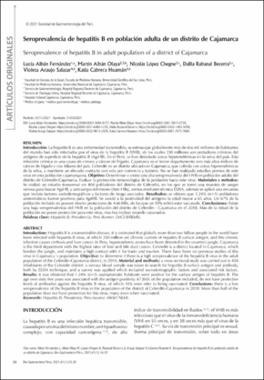
| dc.description.abstract | INTRODUCTION: Hepatitis B is a transmissible disease, it is estimated that globally more than two billion people in the world have been infected with hepatitis B virus, of which 350 million are chronic carriers of hepatitis B surface antigen, and this chronic infection causes cirrhosis and liver cancer. In Peru, hyperendemic zones have been detected in the country's jungle. Cajamarca is the third department with the highest rates of liver and bile duct cancer. Celendín is a district located in Cajamarca, which borders the jungle, and maintains a high contact with it for trade and tourism. There have been no previous studies of this virus in Cajamarca ́s population. OBJECTIVE: to determine if there is a high seroprevalence of the hepatitis B virus in the adult population of the Celendín-Cajamarca district, in 2018. MATERIAL AND METHODS: a cross-sectional study was carried out in 404 inhabitants of the Celendín district: a venous blood sample was taken to search for hepatitis B surface antigen and antibody, both by ELISA technique, and a survey was applied which included sociodemographic factors and associated risk factors. RESULTS: it was obtained that 1.24% (n=5) asymptomatic habitants were positive for the surface antigen of hepatitis B. The age over sixty five years was associated with the antigen positivity. 67.86% of the population included, do not have protective levels of antibodies against the hepatitis B virus, of which 10% even refer to being vaccinated. CONCLUSIONS: there is a low seroprevalence of the hepatitis B virus in the population of the district of Celendín-Cajamarca in 2018. More than half of the population does not have protection for this virus, many even when vaccinated. This record is sourced from MEDLINE/PubMed, a database of the U.S. National Library of Medicine | en_US |
| dc.description.abstract | Introducción: La hepatitis B es una enfermedad transmisible, se estima que globalmente más de dos mil millones de habitantes del mundo han sido infectados por el virus de la hepatitis B (VHB), de los cuales 350 millones son portadores crónicos del antígeno de superficie de la hepatitis B (AgsHB). En el Perú, se han detectado zonas hiperendémicas en la selva del país. Esta infección crónica es una causa de cirrosis y cáncer de hígado. Cajamarca es el tercer departamento con más altos índices de cáncer de hígado y vías biliares del país. Celendín es un distrito ubicado en Cajamarca, que colinda con zonas hiperendémicas de la selva, y mantiene un elevado contacto con esta por comercio y turismo. No se han realizado estudios previos de este virus en esta población cajamarquina. Objetivo: Determinar si existe una alta seroprevalencia del HVB en población adulta del distrito de Celendín-Cajamarca. Evaluar la protección inmunológica de la población hacia este virus. Materiales y métodos: Se realizó un estudio transversal en 404 pobladores del distrito de Celendín, en los que se tomó una muestra de sangre venosa para buscar AgsHB, y anticuerpo del mismo (Anti-HBs), ambos mediante técnica ELISA, además se aplicó una encuesta que incluía factores sociodemográficos y factores de riesgo asociados. Resultados: se obtuvo que 1,24% (n=5) pobladores asintomáticos fueron positivos para AgsHB. Se asoció a la positividad del antígeno la edad mayor a 65 años. Un 67% de la población incluida no poseen niveles protectores de Anti-HBs, de los que un 10% refirió estar vacunado. Conclusiones: Existe una baja seroprevalencia del HVB en la población del distrito de Celendín - Cajamarca en el 2018. Más de la mitad de la población no posee protección para este virus, muchos incluso estando vacunados. | es_PE |
| dc.format | application/pdf | |
| dc.language.iso | spa | |
| dc.publisher | NLM | |
| dc.relation.ispartof | urn:issn:1022-5129 | |
| dc.rights | https://purl.org/coar/access_right/c_abf2 | |
| dc.rights.uri | https://creativecommons.org/licenses/by-nc-sa/4.0/ | |
| dc.subject | SDG 3 | en_US |
| dc.subject | Parasite Dynamics in Livestock and Wildlife | en_US |
| dc.subject | Fascioliasis and Its Global Health Implications | en_US |
| dc.title | Seroprevalencia de hepatitis B en población adulta de un distrito de Cajamarca | es_PE |
| dc.title.alternative | Seroprevalence of hepatitis B in adult population of a district of Cajamarca | en_US |
| dc.type | https://purl.org/coar/resource_type/c_2df8fbb1 | |
| dc.subject.ocde | https://purl.org/pe-repo/ocde/ford#3.02.00 | |
| dc.type.other | Research article | |
| dc.identifier.journal | Revista de gastroenterologia del Peru : organo oficial de la Sociedad de Gastroenterologia del Peru | |
| dc.type.version | https://purl.org/coar/version/c_970fb48d4fbd8a85 |
Files in this item
This item appears in the following Collection(s)
-
Artículos de Investigación [1294]

Except where otherwise noted, this item's license is described as https://purl.org/coar/access_right/c_abf2