Intention to receive the monkeypox vaccine and its psychological and sociodemographic predictors: a cross-sectional survey in the general population of Peru
| dc.contributor.author | Caycho-Rodríguez, T. | |
| dc.contributor.author | Valencia, P.D. | |
| dc.contributor.author | Ventura-León, J. | |
| dc.contributor.author | Carbajal-León, C. | |
| dc.contributor.author | Vilca, L.W. | |
| dc.contributor.author | Gallegos, M. | |
| dc.contributor.author | Reyes-Bossio, M. | |
| dc.contributor.author | Noe-Grijalva, M. | |
| dc.contributor.author | Delgado-Campusano, M. | |
| dc.contributor.author | del Carpio Toia, Á.M. | |
| dc.contributor.author | Torales, J. | |
| dc.contributor.author | Barria-Asenjo, N.A. | |
| dc.date.accessioned | 2025-10-31T18:43:20Z | |
| dc.date.available | 2025-10-31T18:43:20Z | |
| dc.date.issued | 2023 | |
| dc.identifier.uri | https://hdl.handle.net/20.500.12805/6037 | |
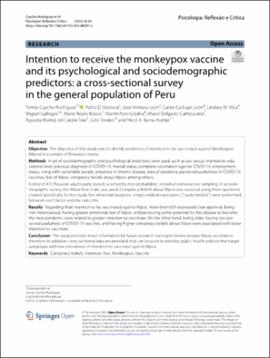
| dc.description.abstract | Objective: The objective of this study was to identify predictors of intention to be vaccinated against Monkeypox (Mpox) in a sample of Peruvian citizens. Methods: A set of sociodemographic and psychological predictors were used, such as sex, sexual orientation, educational level, previous diagnosis of COVID-19, marital status, complete vaccination against COVID-19, employment status, living with vulnerable people, presence of chronic disease, area of residence, perceived usefulness of COVID-19 vaccines, fear of Mpox, conspiracy beliefs about Mpox, among others. A total of 472 Peruvian adults participated, selected by non-probabilistic snowball convenience sampling. A sociodemographic survey, the Mpox Fear Scale, was used. Conspiracy Beliefs about Mpox was assessed using three questions created specifically for this study. For inferential purposes, simple ordinal regressions ("crude models") were performed between each factor and the outcome. Results: Regarding their intention to be vaccinated against Mpox, more than 60% expressed clear approval. Being non-heterosexual, having greater emotional fear of Mpox, and perceiving some potential for this disease to become the next pandemic were related to greater intention to vaccinate. On the other hand, being older, having low perceived usefulness of COVID-19 vaccines, and having higher conspiracy beliefs about Mpox were associated with lower intention to vaccinate. Conclusion: The study provides initial information for future research seeking to better analyze Mpox vaccination intention. In addition, cross-sectional data are provided that can be used to develop public health policies that target subgroups with low prevalence of intention to vaccinate against Mpox. | en_US |
| dc.format | application/pdf | |
| dc.language.iso | eng | |
| dc.publisher | Springer Science and Business Media Deutschland | |
| dc.relation.ispartof | urn:issn:1678-7153 | |
| dc.rights | https://purl.org/coar/access_right/c_abf2 | |
| dc.rights.uri | https://creativecommons.org/licenses/by-nc-sa/4.0/ | |
| dc.subject | Vaccination Strategies Against Emerging Viral Threats | en_US |
| dc.subject | Monkeypox Virus Dynamics and Public Health Response | en_US |
| dc.title | Intention to receive the monkeypox vaccine and its psychological and sociodemographic predictors: a cross-sectional survey in the general population of Peru | en_US |
| dc.type | https://purl.org/coar/resource_type/c_2df8fbb1 | |
| dc.identifier.doi | https://doi.org/10.1186/s41155-023-00281-z | |
| dc.subject.ocde | https://purl.org/pe-repo/ocde/ford#3.03.05 | |
| dc.type.other | Research article | |
| dc.identifier.journal | Psicologia: Reflexao e Critica | |
| dc.type.version | https://purl.org/coar/version/c_970fb48d4fbd8a85 |
Files in this item
This item appears in the following Collection(s)
-
Artículos de Investigación [1294]

Except where otherwise noted, this item's license is described as https://purl.org/coar/access_right/c_abf2