Conocimientos y hábitos alimentarios sobre omega 3 y 6 en universitarios de Ecuador y Perú, en época de COVID-19.
Abstract
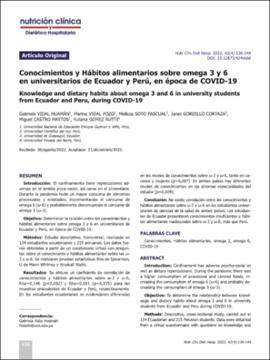
Introduction: Confinement has adverse psycho-social as well as dietary repercussions. During the pandemic there was a higher consumption of processed and canned foods, increasing the consumption of omega 6 (ω-6) and probably decreasing the consumption of omega 3 (ω-3). Objective: To determine the relationship between knowledge and dietary habits about omega 3 and 6 in university students from Ecuador and Peru during COVID-19. Methods: Descriptive, cross-sectional study, carried out in 134 Ecuadorian and 215 Peruvian students. Data were obtained from a virtual questionnaire with questions on knowledge and dietary habits about ω-3 and ω-6. Spearman's Rho, Mann Whitney U and Kruskall Wallis statistical tests were performed. Results: A correlation coefficient of knowledge and eating habits on ω-3 and ω-6, Rho=0.146 (p=0.092) and Rho=0.081 (p=0.235) was obtained for the samples from Ecuador and Peru, respectively. In Ecuadorian students, there were differences in the levels of knowledge about ω-3 and ω-6, both in males and females (p=0.007). In both countries there are different levels of knowledge in the different specialties of the study (p=0.004). Conclusion: There is no correlation between knowledge and eating habits about ω-3 and ω-6 in university students of Health Sciences in both countries. Students from Ecuador present insufficient knowledge and inadequate dietary habits about ω-3 and ω-6, more than Peru. Introducción: El confinamiento tiene repercusiones ad-versas en el ámbito psico-social, así como en el alimentario.Durante la pandemia hubo un mayor consumo de alimentosprocesados y enlatados, incrementando el consumo deomega 6 (ω-6) y probablemente disminuyendo el consumo deomega 3 (ω-3).Objetivo: Determinar la relación entre los conocimientos yhábitos alimentarios sobre omega 3 y 6 en universitarios deEcuador y Perú, en época de COVID-19.Métodos: Estudio descriptivo, transversal, realizado en134 estudiantes ecuatorianos y 215 peruanos. Los datos fue-ron obtenidos a partir de un cuestionario virtual con pregun-tas sobre el conocimiento y hábitos alimentarios sobre los ω-3 y ω-6. Se realizaron pruebas estadísticas Rho de Spearman,U de Mann Whitney y Kruskall Wallis.Resultados: Se obtuvo un coeficiente de correlación deconocimientos y hábitos alimentarios sobre ω-3 y ω-6,Rho=0,146 (p=0,092) y Rho=0,081 (p=0,235) para lasmuestras procedentes de Ecuador y Perú, respectivamente.En los estudiantes ecuatorianos se evidenciaron diferenciasen los niveles de conocimientos sobre ω-3 y ω-6, tanto en va-rones y mujeres (p=0,007). En ambos países hay diferentesniveles de conocimientos en las diversas especialidades delestudio (p=0,004).Conclusión: No existe correlación entre los conocimientos yhábitos alimentarios sobre ω-3 y ω-6 en los estudiantes univer-sitarios de ciencias de la salud de ambos países. Los estudian-tes de Ecuador presentaron conocimientos insuficientes y hábi-tos alimentarios inadecuados sobre ω-3 y ω-6, más que Perú.
Collections
- Artículos de Investigación [1294]

Except where otherwise noted, this item's license is described as https://purl.org/coar/access_right/c_abf2