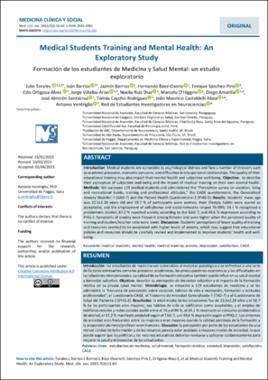
Medical Students Training and Mental Health: An Exploratory Study
| dc.contributor.author | Torales, J. | |
| dc.contributor.author | Barrios, I. | |
| dc.contributor.author | Barrios, J. | |
| dc.contributor.author | Báez-Osorio, H. | |
| dc.contributor.author | Sánchez-Piris, E. | |
| dc.contributor.author | Ortigoza-Alves, E. | |
| dc.contributor.author | Villalba-Arias, J. | |
| dc.contributor.author | Díaz, N.R. | |
| dc.contributor.author | O’higgins, M. | |
| dc.contributor.author | Amarilla, D. | |
| dc.contributor.author | Almirón-Santacruz, J. | |
| dc.contributor.author | Caycho-Rodríguez, T. | |
| dc.contributor.author | Castaldelli-Maia, J.M. | |
| dc.contributor.author | Ventriglio, A. | |
| dc.contributor.author | Torres-Romero, A.D. | |
| dc.contributor.author | Di Giuseppe, M.F. | |
| dc.contributor.author | Rolón-Méndez, E.R. | |
| dc.contributor.author | Martínez-López, P.L. | |
| dc.contributor.author | Heinichen-Mansfeld, K.V. | |
| dc.date.accessioned | 2025-10-31T18:43:02Z | |
| dc.date.available | 2025-10-31T18:43:02Z | |
| dc.date.issued | 2023 | |
| dc.identifier.uri | https://hdl.handle.net/20.500.12805/6016 | |
| dc.description.abstract | Introduction: Medical students are vulnerable to psychological distress and face a number of stressors such as academic pressures, economic concerns, and difficulties in interpersonal relationships. The quality of their educational training may also impact their mental health and subjective well-being. Objective: to describe their perception of subjective well-being and the impact of medical training on their own mental health. Methods: We surveyed 119 medical students and administered the “Perception survey on vocation, living and recreational habits, training and professional attitudes,” the CAGE questionnaire, the Generalized Anxiety Disorder-7 (GAD-7) and the Patient Health Questionnaire-2 (PHQ-2). Results: Students’ mean age was 22.5±2.28 years old and 59.7 % of participants were women, their lifestyle habits were scored as acceptable, and the employment of cell-phones and social networks ranged 76-99%; 24.1 % recognized a problematic alcohol, 67.2 % reported anxiety according to the GAD-7, and 49.6 % depression according to PHQ-2. Symptoms of anxiety were frequent among females and were higher when the perceived quality of training and student/teacher ratio were lower. Discussion: Students’ perceptions of lower quality of training and resources seemed to be associated with higher levels of anxiety, which may suggest that educational policies and resources should be carefully revised and implemented to improve students’ health and well-being. | en_US |
| dc.format | application/pdf | |
| dc.language.iso | eng | |
| dc.publisher | Faculty of Medical Sciences, Santa Rosa del Aguaray Branch, National University of Asuncion | |
| dc.relation.ispartof | urn:issn:2521-2281 | |
| dc.rights | https://purl.org/coar/access_right/c_abf2 | |
| dc.rights.uri | https://creativecommons.org/licenses/by-nc-sa/4.0/ | |
| dc.subject | Burnout and Job Satisfaction in Healthcare Professionals | en_US |
| dc.subject | Mental Health Challenges Among Medical Students | en_US |
| dc.title | Medical Students Training and Mental Health: An Exploratory Study | en_US |
| dc.type | https://purl.org/coar/resource_type/c_2df8fbb1 | |
| dc.identifier.doi | https://doi.org/10.52379/mcs.v7i2.284 | |
| dc.subject.ocde | https://purl.org/pe-repo/ocde/ford#5.03.01 | |
| dc.type.other | Research article | |
| dc.identifier.journal | Medicina Clinica y Social | |
| dc.type.version | https://purl.org/coar/version/c_970fb48d4fbd8a85 |
Files in this item
This item appears in the following Collection(s)
-
Artículos de Investigación [1294]

Except where otherwise noted, this item's license is described as https://purl.org/coar/access_right/c_abf2