Contamination by Antibiotic-Resistant Bacteria on Cell Phones of Vendors in a Peruvian Market
| dc.contributor.author | Gómez-Gonzales, W. | |
| dc.contributor.author | Alvarado-Garcia, A. | |
| dc.contributor.author | Suárez-Mamani, M. | |
| dc.contributor.author | Dámaso-Mata, B. | |
| dc.contributor.author | Panduro-Correa, V. | |
| dc.contributor.author | Maguiña, J.L. | |
| dc.contributor.author | Pecho-Silva, S. | |
| dc.contributor.author | Rabaan, A.A. | |
| dc.contributor.author | Rodriguez-Morales, A.J. | |
| dc.contributor.author | Arteaga-Livias, K. | |
| dc.date.accessioned | 2025-10-31T18:43:00Z | |
| dc.date.available | 2025-10-31T18:43:00Z | |
| dc.date.issued | 2023 | |
| dc.identifier.uri | https://hdl.handle.net/20.500.12805/6013 | |
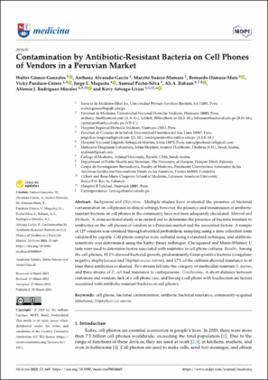
| dc.description.abstract | Background and Objectives. Multiple studies have evaluated the presence of bacterial contamination on cell phones in clinical settings; however, the presence and transmission of antibiotic-resistant bacteria on cell phones in the community have not been adequately elucidated. Material and Methods. A cross-sectional study was carried out to determine the presence of bacteria resistant to antibiotics on the cell phones of vendors in a Peruvian market and the associated factors. A sample of 127 vendors was obtained through stratified probabilistic sampling using a data collection form validated by experts. Cell phone samples were cultured using a standard technique, and antibiotic sensitivity was determined using the Kirby–Bauer technique. Chi-squared and Mann-Whitney U tests were used to determine factors associated with resistance in cell phone cultures. Results. Among the cell phones, 92.1% showed bacterial growth, predominantly Gram-positive bacteria (coagulase-negative staphylococci and Staphylococcus aureus), and 17% of the cultures showed resistance to at least three antibiotics evaluated. Two strains fell into the category of methicillin-resistant S. aureus, and three strains of E. coli had resistance to carbapenems. Conclusions. A short distance between customers and vendors, lack of a cell phone case, and having a cell phone with touchscreen are factors associated with antibiotic-resistant bacteria on cell phones. | en_US |
| dc.description.sponsorship | The project was funded by the Research Department of the Universidad Nacional Hermilio Valdizán, through resolution no. 0146-2020-UNHEVAL-VRI. | |
| dc.format | application/pdf | |
| dc.language.iso | eng | |
| dc.publisher | MDPI | |
| dc.relation.ispartof | urn:issn:1010-660X | |
| dc.rights | https://purl.org/coar/access_right/c_abf2 | |
| dc.rights.uri | https://creativecommons.org/licenses/by-nc-sa/4.0/ | |
| dc.subject | Infection Control Strategies in Health Care Settings | en_US |
| dc.subject | Mobile Device Contamination and Infection Risks | en_US |
| dc.title | Contamination by Antibiotic-Resistant Bacteria on Cell Phones of Vendors in a Peruvian Market | en_US |
| dc.type | https://purl.org/coar/resource_type/c_2df8fbb1 | |
| dc.identifier.doi | https://doi.org/10.3390/medicina59040669 | |
| dc.subject.ocde | https://purl.org/pe-repo/ocde/ford#1.06.01 | |
| dc.type.other | Research article | |
| dc.identifier.journal | Medicina (Lithuania) | |
| dc.type.version | https://purl.org/coar/version/c_970fb48d4fbd8a85 |
Files in this item
This item appears in the following Collection(s)
-
Artículos de Investigación [1294]

Except where otherwise noted, this item's license is described as https://purl.org/coar/access_right/c_abf2