Trends in Mortality from Ischemic Heart Disease in Peru, 2005 to 2017
| dc.contributor.author | Vázquez-Troche, J.A. | |
| dc.contributor.author | García-Fernández, V. | |
| dc.contributor.author | Hernández-Vásquez, A. | |
| dc.contributor.author | Vargas-Fernández, R. | |
| dc.contributor.author | Bendezu-Quispe, G. | |
| dc.date.accessioned | 2025-10-31T18:42:38Z | |
| dc.date.available | 2025-10-31T18:42:38Z | |
| dc.date.issued | 2022 | |
| dc.identifier.uri | https://hdl.handle.net/20.500.12805/5985 | |
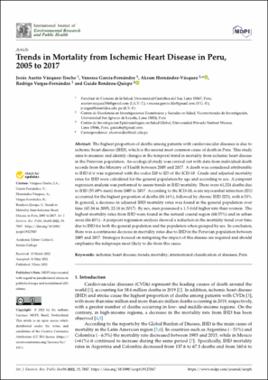
| dc.description.abstract | The highest proportion of deaths among patients with cardiovascular diseases is due to ischemic heart disease (IHD), which is the second most common cause of death in Peru. This study aims to measure and identify changes in the temporal trend in mortality from ischemic heart disease in the Peruvian population. An ecological study was carried out with data from individual death records from the Ministry of Health between 2005 and 2017. A death was considered attributable to IHD if it was registered with the codes I20 to I25 of the ICD-10. Crude and adjusted mortality rates for IHD were calculated for the general population by age and according to sex. A joinpoint regression analysis was performed to assess trends in IHD mortality. There were 61,524 deaths due to IHD (55.69% men) from 2005 to 2017. According to the ICD-10, acute myocardial infarction (I21) accounted for the highest proportion of deaths (88.16%), followed by chronic IHD (I25), with 6.53%. In general, a decrease in adjusted IHD mortality rates was found in the general population over time (45.34 in 2005; 22.18 in 2017). By sex, men possessed a 1.5-fold higher rate than women. The highest mortality rates from IHD were found in the natural coastal region (68.55%) and in urban areas (86.43%). A joinpoint regression analysis showed a reduction in the mortality trend over time due to IHD for both the general population and the population when grouped by sex. In conclusion, there was a continuous decrease in mortality rates due to IHD in the Peruvian population between 2005 and 2017. Strategies focused on mitigating the impact of this disease are required and should emphasize the subgroups most likely to die from this cause. | en_US |
| dc.format | application/pdf | |
| dc.language.iso | eng | |
| dc.publisher | MDPI | |
| dc.relation.ispartof | urn:issn:1661-7827 | |
| dc.rights | https://purl.org/coar/access_right/c_abf2 | |
| dc.rights.uri | https://creativecommons.org/licenses/by-nc-sa/4.0/ | |
| dc.subject | SDG 3 | en_US |
| dc.subject | Hypertension Management and Dietary Sodium Impact | en_US |
| dc.subject | Hypertension Control and Public Health Impact | en_US |
| dc.title | Trends in Mortality from Ischemic Heart Disease in Peru, 2005 to 2017 | en_US |
| dc.type | https://purl.org/coar/resource_type/c_2df8fbb1 | |
| dc.identifier.doi | https://doi.org/10.3390/ijerph19127047 | |
| dc.subject.ocde | https://purl.org/pe-repo/ocde/ford#3.02.06 | |
| dc.type.other | Research article | |
| dc.identifier.journal | International Journal of Environmental Research and Public Health | |
| dc.type.version | https://purl.org/coar/version/c_970fb48d4fbd8a85 |
Files in this item
This item appears in the following Collection(s)
-
Artículos de Investigación [1294]

Except where otherwise noted, this item's license is described as https://purl.org/coar/access_right/c_abf2