Diagnostic Performance of the Measurement of Skinfold Thickness for Abdominal and Overall Obesity in the Peruvian Population: A 5-Year Cohort Analysis
| dc.contributor.author | Rios-Escalante, C. | |
| dc.contributor.author | Albán-Fernández, S. | |
| dc.contributor.author | Espinoza-Rojas, R. | |
| dc.contributor.author | Saavedra-Garcia, L. | |
| dc.contributor.author | Barengo, N.C. | |
| dc.contributor.author | Guerra Valencia, J. | |
| dc.date.accessioned | 2025-10-31T18:42:38Z | |
| dc.date.available | 2025-10-31T18:42:38Z | |
| dc.date.issued | 2023 | |
| dc.identifier.uri | https://hdl.handle.net/20.500.12805/5984 | |
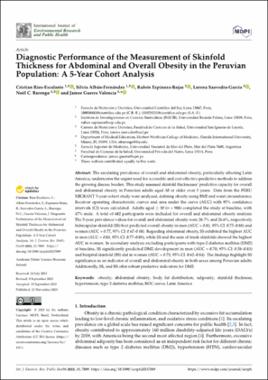
| dc.description.abstract | The escalating prevalence of overall and abdominal obesity, particularly affecting Latin America, underscores the urgent need for accessible and cost-effective predictive methods to address the growing disease burden. This study assessed skinfold thicknesses’ predictive capacity for overall and abdominal obesity in Peruvian adults aged 30 or older over 5 years. Data from the PERU MIGRANT 5-year cohort study were analyzed, defining obesity using BMI and waist circumference. Receiver operating characteristic curves and area under the curve (AUC) with 95% confidence intervals (CI) were calculated. Adults aged ≥ 30 (n = 988) completed the study at baseline, with 47% male. A total of 682 participants were included for overall and abdominal obesity analysis. The 5-year prevalence values for overall and abdominal obesity were 26.7% and 26.6%, respectively. Subscapular skinfold (SS) best predicted overall obesity in men (AUC = 0.81, 95% CI: 0.75–0.88) and women (AUC = 0.77, 95% CI: 0.67–0.88). Regarding abdominal obesity, SS exhibited the highest AUC in men (AUC = 0.83, 95% CI: 0.77–0.89), while SS and the sum of trunk skinfolds showed the highest AUC in women. In secondary analysis excluding participants with type-2 diabetes mellitus (DM2) at baseline, SS significantly predicted DM2 development in men (AUC = 0.70, 95% CI: 0.58–0.83) and bicipital skinfold (BS) did in women (AUC = 0.73, 95% CI: 0.62–0.84). The findings highlight SS significance as an indicator of overall and abdominal obesity in both sexes among Peruvian adults. Additionally, SS, and BS offer robust predictive indicators for DM2. | en_US |
| dc.format | application/pdf | |
| dc.language.iso | eng | |
| dc.publisher | MDPI | |
| dc.relation.ispartof | urn:issn:1661-7827 | |
| dc.rights | https://purl.org/coar/access_right/c_abf2 | |
| dc.rights.uri | https://creativecommons.org/licenses/by-nc-sa/4.0/ | |
| dc.subject | SDG 3 | en_US |
| dc.subject | Obesity, Metabolic Health, and Quality of Life | en_US |
| dc.subject | Obesity Risk Factors and Anthropometric Indices | en_US |
| dc.title | Diagnostic Performance of the Measurement of Skinfold Thickness for Abdominal and Overall Obesity in the Peruvian Population: A 5-Year Cohort Analysis | en_US |
| dc.type | https://purl.org/coar/resource_type/c_2df8fbb1 | |
| dc.identifier.doi | https://doi.org/10.3390/ijerph20237089 | |
| dc.subject.ocde | https://purl.org/pe-repo/ocde/ford#3.02.27 | |
| dc.type.other | Research article | |
| dc.identifier.journal | International Journal of Environmental Research and Public Health | |
| dc.type.version | https://purl.org/coar/version/c_970fb48d4fbd8a85 |
Files in this item
This item appears in the following Collection(s)
-
Artículos de Investigación [1294]

Except where otherwise noted, this item's license is described as https://purl.org/coar/access_right/c_abf2