¿Cómo proteger los humedales costeros peruanos? Una respuesta a partir de un modelo conceptual de sus impulsores de cambio
| dc.contributor.author | Gomez, Á. | |
| dc.contributor.author | Aponte, H. | |
| dc.contributor.author | Gonzales, Y.S. | |
| dc.date.accessioned | 2025-10-31T18:42:21Z | |
| dc.date.available | 2025-10-31T18:42:21Z | |
| dc.date.issued | 2023 | |
| dc.identifier.uri | https://hdl.handle.net/20.500.12805/5962 | |
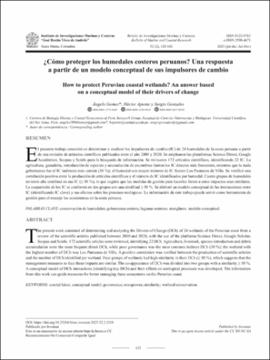
| dc.description.abstract | The present work consisted of determining and analyzing the Drivers of Change (DCh) of 24 wetlands of the Peruvian coast from a review of the scientific articles published between 2000 and 2020, with the use of the platforms Science Direct, Google Scholar, Scopus and Scielo. 172 scientific articles were reviewed, identifying 22 DCh. Agriculture, livestock, species introduction and debris accumulation were the most frequent direct DCh, while poor governance was the most common indirect DCh (38 %); the wetland with the highest number of DCh was Los Pantanos de Villa. A positive correlation was verified between the production of scientific articles and the number of DCh identified per wetland. Four groups of wetlands had high similarity in their DCh (≥ 50 %), which suggests that the management measures to face these impacts are similar. The co-appearance of DCh was divided into two groups with a similarity ≥ 50 %.A conceptual model of DCh interactions (identifying key DCh) and their effects on ecological processes was developed. The informationfrom this work can guide measures for better managing these ecosystems on the Peruvian coast. | en_US |
| dc.format | application/pdf | |
| dc.language.iso | spa | |
| dc.publisher | INVEMAR | |
| dc.relation.ispartof | urn:issn:0122-9761 | |
| dc.rights | https://purl.org/coar/access_right/c_abf2 | |
| dc.rights.uri | https://creativecommons.org/licenses/by-nc-sa/4.0/ | |
| dc.subject | SDG 14 | en_US |
| dc.subject | SDG 15 | en_US |
| dc.subject | Marine Ecosystems and Plastic Waste Management | en_US |
| dc.subject | Wetland Conservation and Biodiversity in Peru | en_US |
| dc.title | ¿Cómo proteger los humedales costeros peruanos? Una respuesta a partir de un modelo conceptual de sus impulsores de cambio | es_PE |
| dc.title.alternative | How to protect Peruvian coastal wetlands? An answer based on a conceptual model of their drivers of change | en_US |
| dc.type | https://purl.org/coar/resource_type/c_2df8fbb1 | |
| dc.identifier.doi | https://doi.org/10.25268/bimc.invemar.2023.52.2.1218 | |
| dc.subject.ocde | https://purl.org/pe-repo/ocde/ford#1.05.00 | |
| dc.type.other | Research article | |
| dc.identifier.journal | Boletin de Investigaciones Marinas y Costeras | |
| dc.type.version | https://purl.org/coar/version/c_970fb48d4fbd8a85 |
Files in this item
This item appears in the following Collection(s)
-
Artículos de Investigación [1294]

Except where otherwise noted, this item's license is described as https://purl.org/coar/access_right/c_abf2