Análisis espacial de la hipertensión arterial en adultos peruanos, 2022
| dc.contributor.author | Hernández-Vásquez, A. | |
| dc.contributor.author | Morote, B.N.C. | |
| dc.contributor.author | Gonzales, V.C.A. | |
| dc.contributor.author | Turpo Cayo, E.Y. | |
| dc.contributor.author | Azañedo, D. | |
| dc.date.accessioned | 2025-10-31T18:42:15Z | |
| dc.date.available | 2025-10-31T18:42:15Z | |
| dc.date.issued | 2023 | |
| dc.identifier.uri | https://hdl.handle.net/20.500.12805/5954 | |
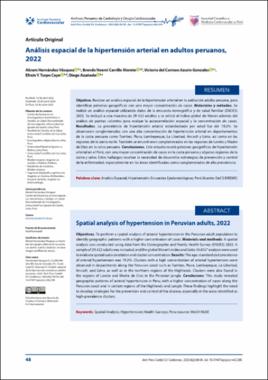
| dc.description.abstract | Objective. To perform a spatial analysis of hypertension in the Peruvian adult population to identify geographic patterns with a higher concentration of cases. Materials and methods. A spatial analysis was conducted using data from the Demographic and Family Health Survey (ENDES) 2022. A sample of 29,422 adults was included, and the global Moran’s index and Getis-Ord Gi* analysis were used to evaluate spatial autocorrelation and cluster concentration. Results. The age-standardized prevalence of hypertension was 19.2%. Clusters with a high concentration of hypertension were observed in departments along the Peruvian coast such as Tumbes, Piura, Lambayeque, La Libertad, Ancash, and Lima, as well as in the northern regions of the Highlands. Clusters were also found in the regions of Loreto and Madre de Dios in the Peruvian jungle. Conclusions. This study revealed geographic patterns of hypertension in Peru, with a higher concentration of cases along the Peruvian coast and in certain regions of the Highlands and Jungle. These findings highlight the need to develop strategies for the prevention and control of the disease, especially in the areas identified as high-prevalence clusters. | en_US |
| dc.description.abstract | Objetivo. Realizar un análisis espacial de la hipertensión arterial en la población adulta peruana, para identificar patrones geográficos con una mayor concentración de casos. Materiales y métodos. Se realizó un análisis espacial utilizando datos de la encuesta demográfica y de salud familiar (ENDES) 2022. Se incluyó a una muestra de 29 422 adultos y se utilizó el índice global de Moran además del análisis de puntos calientes para evaluar la autocorrelación espacial y la concentración de casos. Resultados. La prevalencia de hipertensión arterial estandarizada por edad fue del 19,2%. Se observaron conglomerados con una alta concentración de hipertensión arterial en departamentos de la costa peruana como Tumbes, Piura, Lambayeque, La Libertad, Ancash y Lima, así como en las regiones de la sierra norte. También se encontraron conglomerados en las regiones de Loreto y Madre de Dios en la selva peruana. Conclusiones. Este estudio reveló patrones geográficos de hipertensión arterial en el Perú, con una mayor concentración de casos en la costa peruana y algunas regiones de la sierra y selva. Estos hallazgos resaltan la necesidad de desarrollar estrategias de prevención y control de la enfermedad, especialmente en las áreas identificadas como conglomerados de alta prevalencia. | es_PE |
| dc.format | application/pdf | |
| dc.language.iso | spa | |
| dc.language.iso | eng | |
| dc.publisher | National Cardiovascular Institute - INCOR | |
| dc.relation.ispartof | urn:issn:2708-7212 | |
| dc.rights | https://purl.org/coar/access_right/c_abf2 | |
| dc.rights.uri | https://creativecommons.org/licenses/by-nc-sa/4.0/ | |
| dc.subject | Hypertension Management and Dietary Sodium Impact | en_US |
| dc.subject | Hypertension Control and Public Health Impact | en_US |
| dc.title | Análisis espacial de la hipertensión arterial en adultos peruanos, 2022 | es_PE |
| dc.title.alternative | Spatial analysis of hypertension in Peruvian adults, 2022 | en_US |
| dc.type | https://purl.org/coar/resource_type/c_2df8fbb1 | |
| dc.identifier.doi | https://doi.org/10.47487/apcyccv.v4i2.296 | |
| dc.subject.ocde | https://purl.org/pe-repo/ocde/ford#3.03.00 | |
| dc.type.other | Research article | |
| dc.identifier.journal | Archivos Peruanos de Cardiologia y Cirugia Cardiovascular | |
| dc.type.version | https://purl.org/coar/version/c_970fb48d4fbd8a85 |
Files in this item
This item appears in the following Collection(s)
-
Artículos de Investigación [1294]

Except where otherwise noted, this item's license is described as https://purl.org/coar/access_right/c_abf2