The Broad Range of Coronaviruses Co-Existing in Chiropteran: Implications for One Health
| dc.contributor.author | Katterine Bonilla-Aldana, D. | |
| dc.contributor.author | Toro-Ortiz, C. | |
| dc.contributor.author | Jimenez-Salazar, P. | |
| dc.contributor.author | Guevara-Manso, V. | |
| dc.contributor.author | Daniela Jimenez-Diaz, S. | |
| dc.contributor.author | Bonilla-Aldana, J.L. | |
| dc.contributor.author | Gutierrez-Grajales, E.J. | |
| dc.contributor.author | Pecho-Silva, S. | |
| dc.contributor.author | Paniz-Mondolfi, A. | |
| dc.contributor.author | Suárez, J.A. | |
| dc.contributor.author | Pachar, M.R. | |
| dc.contributor.author | Martinez-Pulgarin, D.F. | |
| dc.contributor.author | Zambrano, L.I. | |
| dc.contributor.author | Soler-Tovar, D. | |
| dc.contributor.author | Rodriguez-Morales, A.J. | |
| dc.contributor.author | Mattar, S. | |
| dc.date.accessioned | 2025-10-31T18:42:06Z | |
| dc.date.available | 2025-10-31T18:42:06Z | |
| dc.date.issued | 2021 | |
| dc.identifier.uri | https://hdl.handle.net/20.500.12805/5943 | |
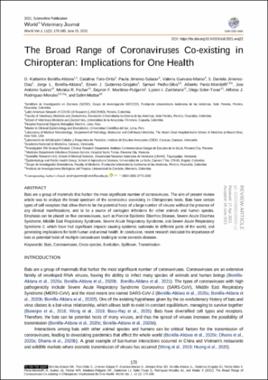
| dc.description.abstract | Bats are a group of mammals that harbor the most significant number of coronaviruses. The aim of present review article was to analyze the broad spectrum of the coronavirus coexisting in Chiropterans hosts. Bats have certain types of cell receptors that allow them to be the potential hosts of a large number of viruses without the presence of any clinical manifestations, and to be a source of contagion infections for other animals and human species. Emphasis can be placed on five coronaviruses, such as Porcine Epidemic Diarrhea Disease, Severe Acute Diarrhea Syndrome, Middle East Respiratory Syndrome, Severe Acute Respiratory Syndrome, and Severe Acute Respiratory Syndrome 2, which have had significant impacts causing epidemic outbreaks in different parts of the world, and generating implications for both human and animal health. In conclusion, recent research indicated the importance of bats as potential hosts of multiple coroaviruses leading to some zoonotic diseases. | en_US |
| dc.description.sponsorship | Funding text 1: The current article was funded by the Dirección de Investigación Científica, Humanística y Tecnológica (2-05-01-01), National Autonomous University of Honduras, Tegucigalpa, MDC, Honduras, Central America.; Funding text 2: Present paper was developed as a part of the classes of Research Methods (Asignatura Metodolog?a de la Investigaci?n) of the School of Veterinary Medicine and Zootechnics, Fundaci?n Universitaria Aut?noma de las Am?ricas, Pereira, Risaralda, Colombia, 2020. | |
| dc.format | application/pdf | |
| dc.language.iso | eng | |
| dc.publisher | Scienceline Publication | |
| dc.relation.ispartof | urn:issn:2322-4568 | |
| dc.rights | https://purl.org/coar/access_right/c_abf2 | |
| dc.rights.uri | https://creativecommons.org/licenses/by-nc-sa/4.0/ | |
| dc.subject | SDG 3 | en_US |
| dc.subject | COVID-19, Its Impact, and Vaccination | en_US |
| dc.subject | Human Coronaviruses and Their Evolution | en_US |
| dc.title | The Broad Range of Coronaviruses Co-Existing in Chiropteran: Implications for One Health | en_US |
| dc.type | https://purl.org/coar/resource_type/c_2df8fbb1 | |
| dc.identifier.doi | https://doi.org/10.54203/scil.2021.wvj22 | |
| dc.subject.ocde | https://purl.org/pe-repo/ocde/ford#3.03.08 | |
| dc.type.other | Research article | |
| dc.identifier.journal | World's Veterinary Journal | |
| dc.type.version | https://purl.org/coar/version/c_970fb48d4fbd8a85 |
Files in this item
This item appears in the following Collection(s)
-
Artículos de Investigación [1294]

Except where otherwise noted, this item's license is described as https://purl.org/coar/access_right/c_abf2