Type 2 diabetes mellitus and anxiety symptoms: A cross-sectional study in Peru
| dc.contributor.author | Bernabe-Ortiz, A. | |
| dc.contributor.author | Arteaga-Zarate, G. | |
| dc.contributor.author | Demarini-Olivares, G. | |
| dc.contributor.author | Torres-Slimming, P.A. | |
| dc.date.accessioned | 2025-10-31T18:41:57Z | |
| dc.date.available | 2025-10-31T18:41:57Z | |
| dc.date.issued | 2022 | |
| dc.identifier.uri | https://hdl.handle.net/20.500.12805/5931 | |
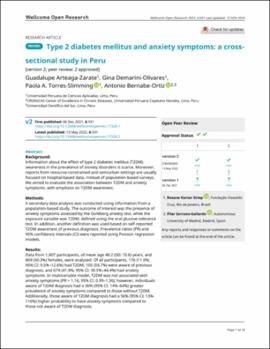
| dc.description.abstract | Background: Information about the effect of type 2 diabetes mellitus (T2DM) awareness in the prevalence of anxiety disorders is scarce. Moreover, reports from resource-constrained and semiurban settings are usually focused on hospital-based data, instead of population-based surveys. We aimed to evaluate the association between T2DM and anxiety symptoms, with emphasis on T2DM awareness. Methods: A secondary data analysis was conducted using information from a population-based study. The outcome of interest was the presence of anxiety symptoms assessed by the Goldberg anxiety test, while the exposure variable was T2DM, defined using the oral glucose tolerance test. In addition, another definition was used based on self-reported T2DM awareness of previous diagnosis. Prevalence ratios (PR) and 95% confidence intervals (CI) were reported using Poisson regression models. Results: Data from 1,607 participants, of mean age 48.2 (SD: 10.6) years, and 809 (50.3%) females, were analyzed. Of all participants, 176 (11.0%; 95% CI: 9.5%-12.6%) had T2DM, 105 (59.7%) were aware of previous diagnosis, and 674 (41.9%; 95% CI: 39.5%-44.4%) had anxiety symptoms. In multivariable model, T2DM was not associated with anxiety symptoms (PR = 1.16; 95% CI: 0.99-1.36); however, individuals aware of T2DM diagnosis had a 36% (95% CI: 14%-64%) greater prevalence of anxiety symptoms compared to those without T2DM. Additionally, those aware of T2DM diagnosis had a 56% (95% CI: 13%-116%) higher probability to have anxiety symptoms compared to those not aware of T2DM diagnosis. Conclusions: The association between T2DM and anxiety symptoms was present among those participants who self-reported T2DM diagnosis, as opposed to those with T2DM but not aware and to those without T2DM. Evaluation of anxiety symptoms may be relevant among those with previous T2DM diagnosis. | en_US |
| dc.format | application/pdf | |
| dc.language.iso | eng | |
| dc.publisher | F1000 Research | |
| dc.relation.ispartof | urn:issn:2398-502X | |
| dc.rights | https://purl.org/coar/access_right/c_abf2 | |
| dc.rights.uri | https://creativecommons.org/licenses/by-nc-sa/4.0/ | |
| dc.subject | SDG 3 | en_US |
| dc.subject | Innovative Approaches in Diabetes Management and Monitoring | en_US |
| dc.subject | Interconnection of Diabetes and Depression Management | en_US |
| dc.title | Type 2 diabetes mellitus and anxiety symptoms: A cross-sectional study in Peru | en_US |
| dc.type | https://purl.org/coar/resource_type/c_2df8fbb1 | |
| dc.identifier.doi | https://doi.org/10.12688/wellcomeopenres.17328.2 | |
| dc.subject.ocde | https://purl.org/pe-repo/ocde/ford#3.02.18 | |
| dc.type.other | Research article | |
| dc.identifier.journal | Wellcome Open Research | |
| dc.type.version | https://purl.org/coar/version/c_970fb48d4fbd8a85 |
Files in this item
This item appears in the following Collection(s)
-
Artículos de Investigación [1294]

Except where otherwise noted, this item's license is described as https://purl.org/coar/access_right/c_abf2