Flat trend of high caesarean section rates in Peru: A pooled analysis of 3,376,062 births from the national birth registry, 2012 to 2020: Caesarean section rates in Peru
| dc.contributor.author | Quezada-Pinedo, H.G. | |
| dc.contributor.author | Cajachagua-Torres, K.N. | |
| dc.contributor.author | Guzman-Vilca, W.C. | |
| dc.contributor.author | Tarazona-Meza, C. | |
| dc.contributor.author | Carrillo-Larco, R.M. | |
| dc.contributor.author | Huicho, L. | |
| dc.date.accessioned | 2025-10-31T18:41:17Z | |
| dc.date.available | 2025-10-31T18:41:17Z | |
| dc.date.issued | 2022 | |
| dc.identifier.uri | https://hdl.handle.net/20.500.12805/5886 | |
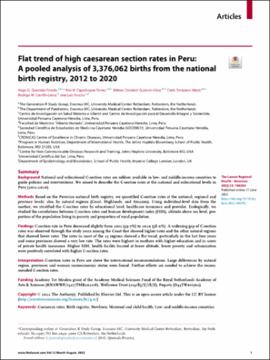
| dc.description.abstract | Background: National and subnational C-section rates are seldom available in low- and middle-income countries to guide policies and interventions. We aimed to describe the C-section rates at the national and subnational levels in Peru (2012-2020). Methods: Based on the Peruvian national birth registry, we quantified C-section rates at the national, regional and province levels; also, by natural regions (Coast, Highlands, and Amazon). Using individual-level data from the mother, we stratified the C-section rates by educational level, healthcare insurance and provider. Ecologically, we studied the correlations between C-section rates and human development index (HDI), altitude above sea level, proportion of the population living in poverty and proportion of rural population. Findings: C-section rate in Peru decreased slightly from 2012 (39·7%) to 2020 (38·0%). A widening gap of C-section rates was observed through the study years among the Coast that showed higher rates and the other natural regions that showed lower rates. The rates in most of the 25 regions showed a flat trend, particularly in the last four years and some provinces showed a very low rate. The rates were highest in mothers with higher education and in users of private health insurance. Higher HDI, health facility located at lower altitude, lower poverty and urbanization were positively correlated with higher C-section rates. Interpretation: C-section rates in Peru are above the international recommendations. Large differences by natural region, provinces and women socioeconomic status were found. Further efforts are needed to achieve the recommended C-section rates. Funding: Academy Ter Meulen grant of the Academy Medical Sciences Fund of the Royal Netherlands Academy of Arts & Sciences (KNAWWF/1327/TMB202116), Wellcome Trust (214185/Z/18/Z), Fogarty (D43TW011502). | en_US |
| dc.description.sponsorship | HGQ-P is supported by Academy Ter Meulen grant of the Academy Medical Sciences Fund of the Royal Netherlands Academy of Arts & Sciences (grant agreement No NAWWF/1327/TMB202116). RMC-L is supported by a Wellcome Trust International Training Fellowship (214185/Z/18/Z). CT-M is supported by the D43-funded Fogarty Research training in Chronic, Non-Communicable Respiratory Diseases in Peru (PulmPERU) training grant (D43TW011502). | |
| dc.format | application/pdf | |
| dc.language.iso | eng | |
| dc.publisher | Elsevier | |
| dc.relation.ispartof | urn:issn:2667-193X | |
| dc.rights | https://purl.org/coar/access_right/c_abf2 | |
| dc.rights.uri | https://creativecommons.org/licenses/by-nc-sa/4.0/ | |
| dc.subject | SDG 1 | en_US |
| dc.subject | SDG 11 | en_US |
| dc.subject | Maternal Health and Delivery Outcomes in Obstetrics | en_US |
| dc.subject | Factors Influencing Cesarean Section Rates and Outcomes | en_US |
| dc.title | Flat trend of high caesarean section rates in Peru: A pooled analysis of 3,376,062 births from the national birth registry, 2012 to 2020: Caesarean section rates in Peru | en_US |
| dc.type | https://purl.org/coar/resource_type/c_2df8fbb1 | |
| dc.identifier.doi | https://doi.org/10.1016/j.lana.2022.100293 | |
| dc.subject.ocde | https://purl.org/pe-repo/ocde/ford#3.02.02 | |
| dc.type.other | Research article | |
| dc.identifier.journal | The Lancet Regional Health - Americas | |
| dc.type.version | https://purl.org/coar/version/c_970fb48d4fbd8a85 |
Files in this item
This item appears in the following Collection(s)
-
Artículos de Investigación [1294]

Except where otherwise noted, this item's license is described as https://purl.org/coar/access_right/c_abf2