Assessment and personalised advice for fatigue in systemic lupus erythematosus using an innovative digital tool: the Lupus Expert system for the Assessment of Fatigue (LEAF) study
| dc.contributor.author | Kawka, L. | |
| dc.contributor.author | Sarmiento-Monroy, J.-C. | |
| dc.contributor.author | Mertz, P. | |
| dc.contributor.author | Pijnenburg, L. | |
| dc.contributor.author | Rinagel, M. | |
| dc.contributor.author | Ugarte-Gil, M.F. | |
| dc.contributor.author | Geneton, S. | |
| dc.contributor.author | Blaess, J. | |
| dc.contributor.author | Piga, M. | |
| dc.contributor.author | Arnaud, L. | |
| dc.date.accessioned | 2025-10-31T18:40:44Z | |
| dc.date.available | 2025-10-31T18:40:44Z | |
| dc.date.issued | 2023 | |
| dc.identifier.uri | https://hdl.handle.net/20.500.12805/5841 | |
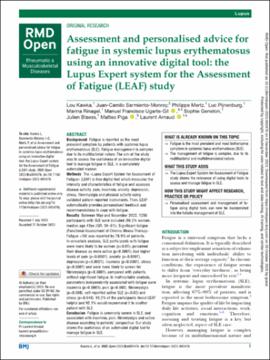
| dc.description.abstract | Background Fatigue is reported as the most prevalent symptom by patients with systemic lupus erythematosus (SLE). Fatigue management is complex due to its multifactorial nature. The aim of the study was to assess the usefulness of an innovative digital tool to manage fatigue in SLE, in a completely automated manner. Methods The «Lupus Expert System for Assessment of Fatigue» (LEAF) is free digital tool which measures the intensity and characteristics of fatigue and assesses disease activity, pain, insomnia, anxiety, depression, stress, fibromyalgia and physical activity using validated patient-reported instruments. Then, LEAF automatically provides personalised feedback and recommendations to cope with fatigue. Results Between May and November 2022, 1250 participants with SLE were included (95.2% women, median age 43yo (IQR: 34-51)). Significant fatigue (Functional Assessment of Chronic Illness Therapy-Fatigue <34) was reported by 78.9% of patients. In univariate analysis, SLE participants with fatigue were more likely to be women (p=0.01), perceived their disease as more active (p<0.0001), had higher levels of pain (p<0.0001), anxiety (p<0.0001), depression (p<0.0001), insomnia (p<0.0001), stress (p<0.0001) and were more likely to screen for fibromyalgia (p<0.0001), compared with patients without significant fatigue. In multivariable analysis, parameters independently associated with fatigue were insomnia (p=0.0003), pain (p=0.002), fibromyalgia (p=0.008), self-reported active SLE (p=0.02) and stress (p=0.045). 93.2% of the participants found LEAF helpful and 92.3% would recommend it to another patient with SLE. Conclusion Fatigue is commonly severe in SLE, and associated with insomnia, pain, fibromyalgia and active disease according to patients' perspective. Our study shows the usefulness of an automated digital tool to manage fatigue in SLE. | en_US |
| dc.description.sponsorship | The authors have not declared a specific grant for this research from any funding agency in the public, commercial or not-for-profit sectors. | |
| dc.format | application/pdf | |
| dc.language.iso | eng | |
| dc.publisher | BMJ Publishing Group | |
| dc.relation.ispartof | urn:issn:2056-5933 | |
| dc.rights | https://purl.org/coar/access_right/c_abf2 | |
| dc.rights.uri | https://creativecommons.org/licenses/by-nc-sa/4.0/ | |
| dc.subject | Systemic Lupus Erythematosus and Patient Outcomes | en_US |
| dc.subject | Systemic Lupus Erythematosus Impact and Management | en_US |
| dc.title | Assessment and personalised advice for fatigue in systemic lupus erythematosus using an innovative digital tool: the Lupus Expert system for the Assessment of Fatigue (LEAF) study | en_US |
| dc.type | https://purl.org/coar/resource_type/c_2df8fbb1 | |
| dc.identifier.doi | https://doi.org/10.1136/rmdopen-2023-003476 | |
| dc.subject.ocde | https://purl.org/pe-repo/ocde/ford#3.02.17 | |
| dc.type.other | Research article | |
| dc.identifier.journal | RMD Open | |
| dc.type.version | https://purl.org/coar/version/c_970fb48d4fbd8a85 |
Files in this item
This item appears in the following Collection(s)
-
Artículos de Investigación [1294]

Except where otherwise noted, this item's license is described as https://purl.org/coar/access_right/c_abf2