Microplásticos e imposex en el caracol marino Thaisella chocolata procedente de la costa central marina del Perú
| dc.contributor.author | Torres-Zevallos, U. | |
| dc.contributor.author | Arenas-Valeriano, A.D. | |
| dc.contributor.author | Alvariño, L. | |
| dc.contributor.author | Iannacone, J. | |
| dc.date.accessioned | 2025-10-31T18:40:40Z | |
| dc.date.available | 2025-10-31T18:40:40Z | |
| dc.date.issued | 2023 | |
| dc.identifier.uri | https://hdl.handle.net/20.500.12805/5836 | |
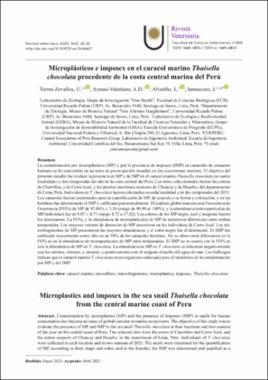
| dc.description.abstract | Contamination by microplastics (MP) and the presence of imposex (IMP) in snails for human consumption has become an issue of global concern in marine ecosystems. The objective of this study was to evaluate the presence of MP and IMP in the sea snail Thaisella chocolata in four locations and two seasons of the year on the central coast of Peru. The selected sites were the coves of Chorrillos and Cerro Azul, and the minor seaports of Chancay and Huacho, in the department of Lima, Peru. Individuals of T. chocolata were collected in each location and in two seasons of 2021. The snails were examined for the quantification of MP, according to their shape and color, and in the females, the IMP was determined and qualified as a percentage. The global analysis shows a Frequency of Occurrence (FO%) of MP of was 97.86% ± 3.34 (range from 90.90 to 100%), and the abundance (MP microparticles/individual) was 9.07 ± 4.71 (range 4.72 to 17.82). The colors of the black, blue and magenta MPs were the dominant ones. The FO%, and the abundance of MP microparticles did not show differences between both seasons. The highest MP detection values occurred in individuals from Cerro Azul. The MP micro-fragments presented the highest abundance and the black color was the dominant one. The IMP was rated as high in 50% of the female snails. No differences were observed in FO% or in the abundance of MP microparticles between seasons. The IMP was not associated with the FO% or with the abundance of MP in T. chocolata. The abundance of MP in T. chocolata was negatively related to nitrites, nitrates, and ammonium, and positively related to dissolved oxygen in seawater. The findings indicate that the marine snail T. chocolata is a suitable organism for monitoring MP and IMP contamination. | en_US |
| dc.format | application/pdf | |
| dc.language.iso | spa | |
| dc.publisher | Universidad Nacional de Nordeste (UNNE) | |
| dc.relation.ispartof | urn:issn:1668-4834 | |
| dc.rights | https://purl.org/coar/access_right/c_abf2 | |
| dc.rights.uri | https://creativecommons.org/licenses/by-nc-sa/4.0/ | |
| dc.subject | SDG 14 | en_US |
| dc.subject | Biodegradable Polymers and Microplastics in Environment | en_US |
| dc.subject | Microplastics as Environmental Pollutants and Risks | en_US |
| dc.title | Microplásticos e imposex en el caracol marino Thaisella chocolata procedente de la costa central marina del Perú | es_PE |
| dc.title.alternative | Microplastics and imposex in the sea snail Thaisella chocolata from the central marine coast of Peru | en_US |
| dc.type | https://purl.org/coar/resource_type/c_2df8fbb1 | |
| dc.identifier.doi | https://doi.org/10.30972/vet.3416607 | |
| dc.subject.ocde | https://purl.org/pe-repo/ocde/ford#1.05.08 | |
| dc.type.other | Research article | |
| dc.identifier.journal | Revista Veterinaria | |
| dc.type.version | https://purl.org/coar/version/c_970fb48d4fbd8a85 |
Files in this item
This item appears in the following Collection(s)
-
Artículos de Investigación [1294]

Except where otherwise noted, this item's license is described as https://purl.org/coar/access_right/c_abf2