Características clínicas y epidemiológicas de las muertes por dengue durante un brote en el norte del Perú
| dc.contributor.author | Luque, N. | |
| dc.contributor.author | Cilloniz, C. | |
| dc.contributor.author | Pons, M.J. | |
| dc.contributor.author | Donaires, F. | |
| dc.contributor.author | Albornoz, R. | |
| dc.contributor.author | Mendocilla-Risco, M. | |
| dc.contributor.author | Espinoza, M. | |
| dc.date.accessioned | 2025-10-31T18:40:36Z | |
| dc.date.available | 2025-10-31T18:40:36Z | |
| dc.date.issued | 2023 | |
| dc.identifier.uri | https://hdl.handle.net/20.500.12805/5830 | |
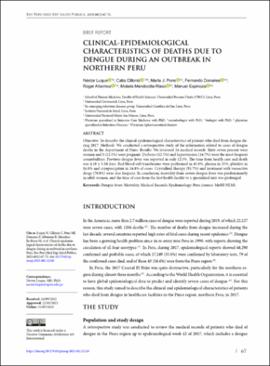
| dc.description.abstract | Objective: To describe the clinical-epidemiological characteristics of patients who died from dengue during 2017. Methods: We conducted a retrospective study of the information related to cases of dengue deaths in the department of Piura. Results: We reviewed 24 medical records. Sixty-seven percent were women and 3 (12.5%) were pregnant. Diabetes (12.5%) and hypertension (16.7%) were the most frequent comorbidities. Previous dengue fever was reported in only 12.5%. The time from health care and death was 4.10 ± 5.34 days. Red blood cell transfusions were performed in 45.8%, plasma in 25%, platelets in 16.8% and cryoprecipitate in 16.8% of cases. Crystalloid therapy (91.7%) and treatment with vasoactive drugs (70.8%) were also frequent. In conclusion, mortality from severe dengue fever was predominantly in adult women, and the time of care from the first health facility to a specialized unit was prolonged. | en_US |
| dc.description.abstract | Con el objetivo de describir las características clínicas y epidemiológicas de los pacientes fallecidos por dengue durante el 2017 en Piura, se realizó un estudio retrospectivo de revisión de 24 historias clínicas. El 67% de los casos fueron mujeres y tres (12,5%) estaban embarazadas. La diabetes (12,5%) y la hipertensión (16,7%) fueron las comorbilidades más frecuentes. Sólo en el 12,5% se reportó dengue previo. El tiempo transcurrido desde asistencia sanitaria hasta la muerte fue de 4,10 (DE: 5,34) días. Se hicieron transfusiones de glóbulos rojos en el 45,8% de los casos, plasma en el 25%, plaquetas en el 16,8% y crioprecipitado en el 16,8%. También fueron frecuentes la terapia con ristaloides (91,7%) y el tratamiento con fármacos vasoactivos (70,8%). En conclusión, la mortalidad del dengue grave fue mayoritaria en las mujeres adultas y el tiempo de atención desde el primer establecimiento de salud hasta una unidad especializada fue prolongada. | es_PE |
| dc.format | application/pdf | |
| dc.language.iso | spa | |
| dc.language.iso | eng | |
| dc.publisher | Instituto Nacional de Salud (Perú) | |
| dc.relation.ispartof | urn:issn:1726-4642 | |
| dc.rights | https://purl.org/coar/access_right/c_abf2 | |
| dc.rights.uri | https://creativecommons.org/licenses/by-nc-sa/4.0/ | |
| dc.subject | SDG 3 | en_US |
| dc.subject | Dengue and Zika Virus Dynamics in Public Health | en_US |
| dc.subject | Dengue Virus Dynamics and Vaccine Development | en_US |
| dc.title | Características clínicas y epidemiológicas de las muertes por dengue durante un brote en el norte del Perú | es_PE |
| dc.title.alternative | Clinical-epidemiological characteristics of dengue deaths during an outbreak in northern Peru | en_US |
| dc.type | https://purl.org/coar/resource_type/c_2df8fbb1 | |
| dc.identifier.doi | https://doi.org/10.17843/rpmesp.2023.401.12148 | |
| dc.subject.ocde | https://purl.org/pe-repo/ocde/ford#3.03.08 | |
| dc.type.other | Research article | |
| dc.identifier.journal | Revista Peruana de Medicina Experimental y Salud Pública | |
| dc.type.version | https://purl.org/coar/version/c_970fb48d4fbd8a85 |
Files in this item
This item appears in the following Collection(s)
-
Artículos de Investigación [1294]

Except where otherwise noted, this item's license is described as https://purl.org/coar/access_right/c_abf2