Actividad antitumoral de biopolímeros aislados de Vibrio sp. en cáncer de mama inducido en ratas
| dc.contributor.author | Flores-Cortez, D. | |
| dc.contributor.author | Villalobos-Pacheco, E. | |
| dc.contributor.author | Chávez-Rojas, D. | |
| dc.contributor.author | Rodriguez-Tafur Dávila, J. | |
| dc.contributor.author | Palomino-Yamamoto, M. | |
| dc.date.accessioned | 2025-10-31T18:40:29Z | |
| dc.date.available | 2025-10-31T18:40:29Z | |
| dc.date.issued | 2020 | |
| dc.identifier.uri | https://hdl.handle.net/20.500.12805/5820 | |
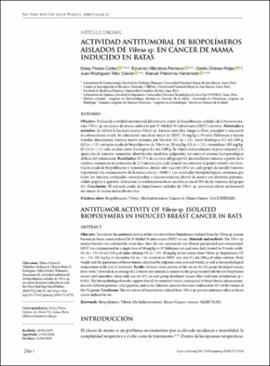
| dc.description.abstract | Objective: To evaluate the antitumor activity of the raw extract from biopolymers isolated from the Vibrio sp. marine bacteria in breast cancer induced by N-Methyl-N-nitrosourea (MNU) in rats. Materials and methods: The Vibrio sp. marine bacteria was cultured for seven days, then the raw supernatant was filtered, precipitated and concentrated. MNU was administered in a single dose of 50 mg/kg to 39 Holtzman rats and were daily treated for 9 weeks orally: G1 (n = 13): 0.1 mL/100 g of saline solution; G2 (n = 13): 20 mg/kg of raw extract from Vibrio sp. biopolymers; G3 (n = 13): 100 mg/kg of tamoxifen; G4 (n = 11) received no MNU and only 0.1 mL/100 g of saline solution. Body weight and the appearance of breast tumors identified by palpation were assessed weekly, as well as histopathological examination at the end of treatment. Results: Seventy-seven percent of the rats in the G1 group developed tumors from week 7 onwards in an average of 2.2 tumors per animal; in contrast to the group treated with the raw biopolymer extract and tamoxifen; where only one rat (8%) in each group developed tumors after week nine of induction (p = 0.001). The histopathological results support that all the removed tumors correspond to breast ductal adenocarcinoma with different patterns: solid, papillary and cystic. Likewise, necrotic foci were evidenced in 30% of the tumors of the G1 group. Conclusion: The raw extract of biopolymers isolated from Vibrio sp. present antitumor effect in breast cancer induced in rats. | en_US |
| dc.description.sponsorship | Agradecimientos: A la Dra. Rita Orozco Moreira del Laboratorio de Microbiología del Instituto del Mar del Perú y al Dr. Hernán Velarde del Instituto de Patología de la Facultad de Medicina de la UNMSM, El proyecto fue financiado por el Vicerrectorado de Investigación de la UNMSM (Resolución Rectoral N.° 01414-R-12. Código del proyecto: 120114011). | |
| dc.format | application/pdf | |
| dc.language.iso | spa | |
| dc.publisher | Instituto Nacional de Salud (Perú) | |
| dc.relation.ispartof | urn:issn:1726-4642 | |
| dc.rights | https://purl.org/coar/access_right/c_abf2 | |
| dc.rights.uri | https://creativecommons.org/licenses/by-nc-sa/4.0/ | |
| dc.subject | SDG 3 | en_US |
| dc.subject | Ubiquinone Effects on Cancer and Marine Diversity | en_US |
| dc.subject | Marine Bacteria as Antiinfective Agents and Antibiotics | en_US |
| dc.title | Actividad antitumoral de biopolímeros aislados de Vibrio sp. en cáncer de mama inducido en ratas | es_PE |
| dc.title.alternative | Antitumor activity of Vibrio sp. isolated biopolymers in induced breast cancer in rats | en_US |
| dc.type | https://purl.org/coar/resource_type/c_2df8fbb1 | |
| dc.identifier.doi | https://doi.org/10.17843/RPMESP.2020.372.4756 | |
| dc.subject.ocde | https://purl.org/pe-repo/ocde/ford#3.02.21 | |
| dc.type.other | Research article | |
| dc.identifier.journal | Revista Peruana de Medicina Experimental y Salud Pública | |
| dc.type.version | https://purl.org/coar/version/c_970fb48d4fbd8a85 |
Files in this item
This item appears in the following Collection(s)
-
Artículos de Investigación [1294]

Except where otherwise noted, this item's license is described as https://purl.org/coar/access_right/c_abf2