Actividad citotóxica de la fracción clorofórmica de Piper aduncum y su efecto en el ciclo celular en líneas celulares de cáncer gástrico
| dc.contributor.author | Mayanga-Herrera, A. | |
| dc.contributor.author | Tapia-Rojas, S. | |
| dc.contributor.author | Fukusaki-Yoshizawa, A. | |
| dc.contributor.author | Marcelo-Rodríguez, Á. | |
| dc.contributor.author | Amiel-Pérez, J. | |
| dc.date.accessioned | 2025-10-31T18:40:26Z | |
| dc.date.available | 2025-10-31T18:40:26Z | |
| dc.date.issued | 2020 | |
| dc.identifier.uri | https://hdl.handle.net/20.500.12805/5817 | |
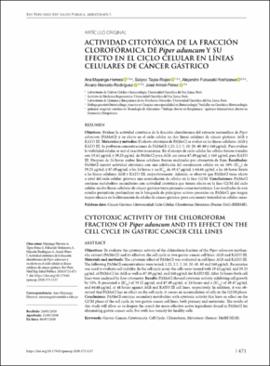
| dc.description.abstract | Objetives: To evaluate the cytotoxic activity of the chloroform fraction of the Piper aduncum methanolic extract (PAMoCl) and its effect on the cell cycle in two gastric cancer cell lines: AGS and KATO III. Materials and methods: The cytotoxic effect of PAMoCl was evaluated in cell lines AGS and KATO III. The following PAMoCl concentrations were tested, 1.25, 2.5, 5, 10, 20, 40, 80 and 160 μg/mL. Resazurine was used to evaluate cell viability. In the cell cycle assay, the cells were treated with 19.62 μg/mL and 39.23 μg/mL of PAMoCl for AGS as well as 87.49 μg/mL and 160 μg/mL for KATO III. After 24 hours both cell lines were analyzed by flow cytometry. Results: PAMoCl showed cytotoxic activity, inhibiting cell growth by 50%. It presented a (IC50) of 39.23 μg/mL and 87.49 μg/mL at 24 hours and a (IC50) of 49.47 μg/mL and 64.68 μg/mL at 48 hours against AGS and KATO III cell lines, respectively. In addition, it was observed that PAMoCl has an effect on the cell cycle, it causes an accumulation of cells in the G2/M phase. Conclusions: PAMoCl contains secondary metabolites with cytotoxic activity that have an effect on the G2/M phase of the cell cycle, in two gastric cancer cell lines, both primary and metastatic. The results of this study will allow us to deepen the search for more effective active ingredients found in PAMoCl for eliminating gastric cancer cells, but with less toxicity for healthy cells. | en_US |
| dc.description.abstract | Objetivos: Evaluar la actividad citotóxica de la fracción clorofórmica del extracto metanólico de Piper aduncum (PAMoCl) y su efecto en el ciclo celular en dos líneas celulares de cáncer gástrico: AGS y KATO III. Materiales y métodos: El efecto citotóxico de PAMoCl se evaluó en las líneas celulares: AGS y KATO III. Se probaron concentraciones de PAMoCl: 1,25; 2,5; 5; 10; 20; 40; 80 y 160 µg/mL. Para evaluar la viabilidad celular se usó el reactivo resazurina. En el ensayo de ciclo celular las células fueron tratadas con 19,62 µg/mL y 39,23 µg/mL de PAMoCl para AGS, así como 87,49 µg/mL y 160 µg/mL para KATO III. Después de 24 horas ambas líneas celulares fueron analizadas por citometría de flujo. Resultados: PAMoCl mostró actividad citotóxica con una inhibición del crecimiento celular en un 50% (IC50) de 39,23 µg/mL y 87,49 µg/mL a las 24 horas y un IC50 de 49,47 µg/mL y 64,68 µg/mL a las 48 horas frente a las líneas celulares AGS y KATO III, respectivamente. Además, se observó que PAMoCl tiene efecto a nivel del ciclo celular: provoca una acumulación de células en la fase G2/M. Conclusiones: PAMoCl contiene metabolitos secundarios con actividad citotóxica que tienen efecto en la fase G2/M del ciclo celular, en dos líneas celulares de cáncer gástrico tanto primario como metastásico. Los resultados de este estudio permitirán profundizar en la búsqueda de principios activos presentes en PAMoCl que tengan mayor eficacia en la eliminación de células de cáncer gástrico, pero con menor toxicidad en células sanas. | es_PE |
| dc.format | application/pdf | |
| dc.language.iso | spa | |
| dc.language.iso | eng | |
| dc.publisher | Instituto Nacional de Salud (Perú) | |
| dc.relation.ispartof | urn:issn:1726-4642 | |
| dc.rights | https://purl.org/coar/access_right/c_abf2 | |
| dc.rights.uri | https://creativecommons.org/licenses/by-nc-sa/4.0/ | |
| dc.subject | SDG 3 | en_US |
| dc.subject | Medicinal Plant Extracts for Pain Management | en_US |
| dc.subject | Therapeutic Potential of Vitex Compounds and Extracts | en_US |
| dc.title | Actividad citotóxica de la fracción clorofórmica de Piper aduncum y su efecto en el ciclo celular en líneas celulares de cáncer gástrico | es_PE |
| dc.title.alternative | Cytotoxic activity of the chloroform fraction of Piper aduncum and its effect on the cell cycle in gastric cancer cell lines | en_US |
| dc.type | https://purl.org/coar/resource_type/c_2df8fbb1 | |
| dc.identifier.doi | https://doi.org/10.17843/rpmesp.2020.373.5157 | |
| dc.subject.ocde | https://purl.org/pe-repo/ocde/ford#3.01.05 | |
| dc.type.other | Research article | |
| dc.identifier.journal | Revista Peruana de Medicina Experimental y Salud Pública | |
| dc.type.version | https://purl.org/coar/version/c_970fb48d4fbd8a85 |
Files in this item
This item appears in the following Collection(s)
-
Artículos de Investigación [1294]

Except where otherwise noted, this item's license is described as https://purl.org/coar/access_right/c_abf2