Estudio exploratorio sobre conocimientos y frecuencia de consumo de productos procesados y ultraprocesados en estudiantes universitarios de Perú
| dc.contributor.author | Mamani-Urrutia, V. | |
| dc.contributor.author | Dominguez-Curi, C.H. | |
| dc.contributor.author | Sosa-Macalupu, M.A. | |
| dc.contributor.author | Torres-Vicharra, L.F. | |
| dc.contributor.author | Bustamante-López, A. | |
| dc.date.accessioned | 2025-10-31T18:39:54Z | |
| dc.date.available | 2025-10-31T18:39:54Z | |
| dc.date.issued | 2022 | |
| dc.identifier.uri | https://www.renc.es/imagenes/auxiliar/files/RENC-D-21-0019._ORIGINAL.pdf | |
| dc.identifier.uri | https://hdl.handle.net/20.500.12805/5769 | |
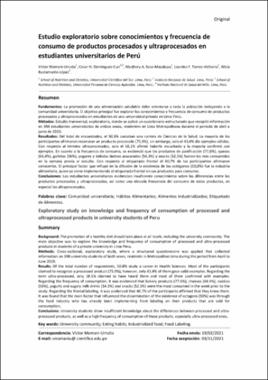
| dc.description.abstract | Background: The promotion of a healthy diet should take place at all levels, including the university community. The main objective was to explore the knowledge and frequency of consumption of processed and ultra-processed products in students of a private university in Lima-Peru. Methods: Cross-sectional, exploratory study, where a structured questionnaire was applied that collected information on 398 university students of both sexes, residents in Metropolitan Lima during the period from April to June 2019. Results: Of the total number of respondents, 50.8% study a career in Health Sciences. Most of the participants claimed to recognize a processed product (75.9%), however, only 43.4% of them gave valid examples. Regarding the term ultra-processed, only 18.1% claimed to have heard them and most of them confirmed with examples. Regarding the frequency of consumption, it was evidenced that bakery products (77.6%), cheeses (64.4%), cookies (56%), yogurts and sugary milk drinks (54.3%) and snacks (52.5%) were the most consumed in the week prior to the study. Regarding the frontal labeling, it was evidenced that 40.7% of the participants affirmed that they knew them. It was found that the main factor that influenced the dissemination of the existence of octagons (50%) was through the food industry who has already been implementing front labeling on their products that are sold for consumption. Conclusions: University students show insufficient knowledge about the differences between processed and ultraprocessed products, as well as a high frequency of consumption of these products, especially ultra-processed ones. | en_US |
| dc.format | application/pdf | |
| dc.language.iso | spa | |
| dc.publisher | Sociedad Española de Nutricion Comunitaria | |
| dc.relation.ispartof | urn:issn:1135-3074 | |
| dc.rights | https://purl.org/coar/access_right/c_abf2 | |
| dc.rights.uri | https://creativecommons.org/licenses/by-nc-sa/4.0/ | |
| dc.subject | Physical Activity and Health Promotion Strategies | en_US |
| dc.subject | Health and Lifestyle Patterns Among University Students | en_US |
| dc.title | Estudio exploratorio sobre conocimientos y frecuencia de consumo de productos procesados y ultraprocesados en estudiantes universitarios de Perú | es_PE |
| dc.title.alternative | Exploratory study on knowledge and frequency of consumption of processed and ultraprocessed products in university students of Peru | en_US |
| dc.type | https://purl.org/coar/resource_type/c_2df8fbb1 | |
| dc.subject.ocde | https://purl.org/pe-repo/ocde/ford#3.03.04 | |
| dc.type.other | Research article | |
| dc.identifier.journal | Revista Espanola de Nutricion Comunitaria | |
| dc.type.version | https://purl.org/coar/version/c_970fb48d4fbd8a85 |
Files in this item
This item appears in the following Collection(s)
-
Artículos de Investigación [1294]

Except where otherwise noted, this item's license is described as https://purl.org/coar/access_right/c_abf2