Asociación entre nivel socioeconómico y riesgo cardiovascular en la población peruana
| dc.contributor.author | Cerpa-Arana, S.K. | |
| dc.contributor.author | Rimarachín-Palacios, L.M. | |
| dc.contributor.author | Bernabé-Ortiz, A. | |
| dc.date.accessioned | 2025-10-31T18:39:25Z | |
| dc.date.available | 2025-10-31T18:39:25Z | |
| dc.date.issued | 2022 | |
| dc.identifier.uri | https://hdl.handle.net/20.500.12805/5724 | |
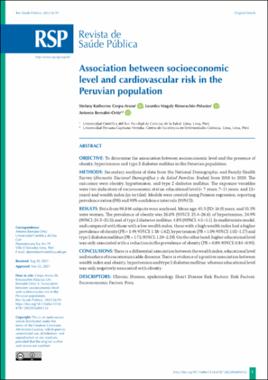
| dc.description.abstract | OBJECTIVE: To determine the association between socioeconomic level and the presence of obesity, hypertension and type 2 diabetes mellitus in the Peruvian population.METHODS: Secondary analysis of data from the National Demographic and Family Health Survey (Encuesta Nacional Demográfica y de Salud Familiar, Endes) from 2018 to 2020. The outcomes were obesity, hypertension, and type 2 diabetes mellitus. The exposure variables were two indicators of socioeconomic status: educational level (< 7 years, 7–11 years, and 12+ years) and wealth index (in tertiles). Models were created using Poisson regression, reporting prevalence ratios (PR) and 95% confidence intervals (95%CI).RESULTS: Data from 98,846 subjects were analyzed. Mean age: 45.3 (SD: 16.0) years, and 55.5% were women. The prevalence of obesity was 26.0% (95%CI: 25.4–26.6); of hypertension, 24.9% (95%CI: 24.3–25.5); and of type 2 diabetes mellitus, 4.8% (95%CI: 4.5–5.1). In multivariate model, and compared with those with a low wealth index, those with a high wealth index had a higher prevalence of obesity (PR = 1.49; 95%CI: 1.38–1.62), hypertension (PR = 1.09; 95%CI: 1.02–1.17) and type 2 diabetes mellitus (PR = 1.72; 95%CI: 1.29–2.29). On the other hand, higher educational level was only associated with a reduction in the prevalence of obesity (PR = 0.89; 95%CI: 0.84–0.95).CONCLUSIONS: There is a differential association between the wealth index, educational level and markers of noncommunicable diseases. There is evidence of a positive association between wealth index and obesity, hypertension and type 2 diabetes mellitus, whereas educational level was only negatively associated with obesity. | en_US |
| dc.description.abstract | OBJETIVO: Determinar la asociación entre el nivel socioeconómico y la presencia de obesidad, hipertensión y diabetes mellitus tipo 2 en la población peruana. MÉTODOS: Análisis de datos secundarios de la Encuesta Nacional Demográfica y de Salud Familiar (Endes) del 2018 al 2020. Las variables dependientes fueron obesidad, hipertensión y diabetes mellitus tipo 2, y las variables independientes fueron dos indicadores de nivel socioeconómico: el nivel educativo (< 7 años, 7–11 años y 12+ años) y el índice de bienestar (en terciles). Se crearon modelos usando regresión de Poisson, reportando razones de prevalencia (RP) e intervalos de confianza al 95% (IC95%). RESULTADOS: Se analizaron los datos de 98.846 sujetos, edad promedio: 45,3 (DE: 16,0) años, y 55,5% fueron mujeres. La prevalencia de obesidad fue del 26% (IC95% 25,4–26,6); la de hipertensión, 24,9% (IC95% 24,3–25,5); y la de diabetes mellitus tipo 2, 4,8% (IC95% 4,5–5,1). En modelo multivariable y comparado con los de índice de bienestar bajo, aquellos con índice de bienestar alto tenían mayor prevalencia de obesidad (RP = 1,49; IC95% 1,38–1,62), de hipertensión (RP = 1,09; IC95% 1,02–1,17) y de diabetes mellitus tipo 2 (RP = 1,72; IC95% 1,29–2,29). De otro lado, mayor nivel educativo sólo se asoció a una reducción en la prevalencia de obesidad (RP = 0,89; IC95% 0,84–0,95). CONCLUSIONES: Existe asociación diferencial entre el índice de bienestar, nivel educativo y marcadores de enfermedades no transmisibles: hay evidencia de asociación positiva entre el índice de bienestar y obesidad, hipertensión y diabetes mellitus tipo 2, mientras que el nivel educativo solo estuvo asociado de forma negativa a obesidad. DESCRITORES: Enfermedad Crónica, epidemiología. Factores de Riesgo de Enfermedad Cardiaca. Factores de Riesgo. Factores Socioeconómicos. Perú © 2023 Elsevier B.V., All rights reserved. | es_PE |
| dc.format | application/pdf | |
| dc.language.iso | spa | |
| dc.language.iso | eng | |
| dc.publisher | Universidade de Sao Paulo, Museu de Zoología | |
| dc.relation.ispartof | urn:issn:0034-8910 | |
| dc.rights | https://purl.org/coar/access_right/c_abf2 | |
| dc.rights.uri | https://creativecommons.org/licenses/by-nc-sa/4.0/ | |
| dc.subject | SDG 3 | en_US |
| dc.subject | Obesity, Metabolic Health, and Quality of Life | en_US |
| dc.subject | Prevalence of Obesity and Malnutrition Dynamics | en_US |
| dc.title | Asociación entre nivel socioeconómico y riesgo cardiovascular en la población peruana | es_PE |
| dc.title.alternative | Association between socioeconomic level and cardiovascular risk in the Peruvian population | en_US |
| dc.type | https://purl.org/coar/resource_type/c_2df8fbb1 | |
| dc.identifier.doi | https://doi.org/10.11606/S1518-8787.2022056004132 | |
| dc.subject.ocde | https://purl.org/pe-repo/ocde/ford#3.03.09 | |
| dc.type.other | Research article | |
| dc.identifier.journal | Revista de Saude Publica | |
| dc.type.version | https://purl.org/coar/version/c_970fb48d4fbd8a85 |
Files in this item
This item appears in the following Collection(s)
-
Artículos de Investigación [1294]

Except where otherwise noted, this item's license is described as https://purl.org/coar/access_right/c_abf2