Huntington juvenil y fenocopia intrafamiliar a propósito de dos casos
| dc.contributor.author | Silva-Bullón, M. | |
| dc.contributor.author | Toledo-Pacheco, B. | |
| dc.contributor.author | Illanes-Manrique, M. | |
| dc.contributor.author | Cubas-Montecino, D. | |
| dc.contributor.author | Cornejo-Olivas, M. | |
| dc.date.accessioned | 2025-10-31T18:39:23Z | |
| dc.date.available | 2025-10-31T18:39:23Z | |
| dc.date.issued | 2023 | |
| dc.identifier.uri | https://hdl.handle.net/20.500.12805/5721 | |
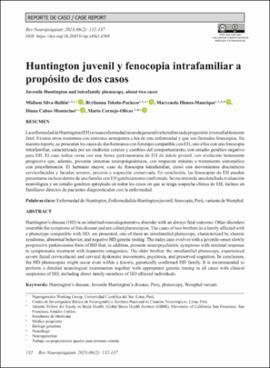
| dc.description.abstract | Huntington’s disease (HD) is an inherited neurodegenerative disorder with an always fatal outcome. Other disorders resemble the symptoms of this disease and are called phenocopies. The cases of two brothers in a family affected with a phenotype compatible with HD, are presented, one of them an intrafamilial phenocopy, characterized by choreic syndrome, abnormal behavior, and negative HD genetic testing. The index case evolves with a juvenile-onset slowly progressive parkinsonian form of HD that, in addition, presents neuropsychiatric symptoms with minimal response to symptomatic treatment with dopamine antagonists. The older brother, the intrafamilial phenocopy, experienced severe facial cervicofacial and cervical dyskinetic movements, psychosis, and preserved cognition. In conclusion, the HD phenocopies might occur even within a known, genetically confirmed HD family. It is recommended to perform a detailed neurological examination together with appropriate genetic testing in all cases with clinical suspicious of HD, including direct family members of HD affected individuals. | en_US |
| dc.description.abstract | La enfermedad de Huntington (EH) es una enfermedad neurodegenerativa hereditaria de progresión irremediablemente fatal. Existen otros trastornos con síntomas semejantes a los de esta enfermedad y que son llamados fenocopias. En nuestro reporte, se presentan los casos de dos hermanos con fenotipo compatible con EH, uno ellos con una fenocopia intrafamiliar, caracterizada por un síndrome coreico y cambios del comportamiento, con estudio genético negativo para EH. El caso índice cursa con una forma parkinsoniana de EH de inicio juvenil, con evolución lentamente progresiva que, además, presenta síntomas neuropsiquiátricos, con respuesta mínima a tratamiento sintomático con psicofármacos. El hermano mayor, caso de fenocopia intrafamiliar, cursó con movimientos discinéticos cervicofaciales y faciales severos, psicosis y cognición conservada. En conclusión, las fenocopias de EH pueden presentarse incluso dentro de una familia con EH genéticamente confirmada. Se recomienda una detallada evaluación neurológica y un estudio genético apropiado en todos los casos en que se tenga sospecha clínica de EH, incluso en familiares directos de pacientes diagnosticados con la enfermedad. | es_PE |
| dc.format | application/pdf | |
| dc.language.iso | spa | |
| dc.publisher | Facultad de Medicina Alberto Hurtado, Universidad Peruana Cayetano Heredia | |
| dc.relation.ispartof | urn:issn:1609-7394 | |
| dc.rights | https://purl.org/coar/access_right/c_abf2 | |
| dc.rights.uri | https://creativecommons.org/licenses/by-nc-sa/4.0/ | |
| dc.subject | Parkinson's Disease: Gait, Cognition, and Quality of Life | en_US |
| dc.subject | Cognitive and Motor Challenges in Huntington's Disease | en_US |
| dc.title | Huntington juvenil y fenocopia intrafamiliar a propósito de dos casos | es_PE |
| dc.type | https://purl.org/coar/resource_type/c_2df8fbb1 | |
| dc.identifier.doi | https://doi.org/10.20453/rnp.v86i3.4560 | |
| dc.subject.ocde | https://purl.org/pe-repo/ocde/ford#3.02.25 | |
| dc.type.other | Research article | |
| dc.identifier.journal | Revista de Neuro-Psiquiatria | |
| dc.type.version | https://purl.org/coar/version/c_970fb48d4fbd8a85 |
Files in this item
This item appears in the following Collection(s)
-
Artículos de Investigación [1294]

Except where otherwise noted, this item's license is described as https://purl.org/coar/access_right/c_abf2