Metales pesados e imposex en Thaisella chocolata (Gasteropoda: Muricidae) en Matarani, Arequipa, Perú
| dc.contributor.author | Luna-Pacompea, N. | |
| dc.contributor.author | Juárez-Laguna, F. | |
| dc.contributor.author | Jaén-Rodriguez, C. | |
| dc.contributor.author | Alvariño, L. | |
| dc.contributor.author | Iannacone, J. | |
| dc.date.accessioned | 2025-10-31T18:38:39Z | |
| dc.date.available | 2025-10-31T18:38:39Z | |
| dc.date.issued | 2022 | |
| dc.identifier.uri | https://hdl.handle.net/20.500.12805/5647 | |
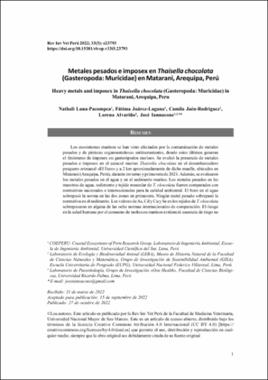
| dc.description.abstract | Marine ecosystems have been affected by contamination from heavy metals and antifouling organotin paints, where the latter generate the imposex phenomenon in marine gastropods. The presence of heavy metals and imposex in the marine snail Thaisella chocolata was evaluated at the «El Faro» artisanal fishing landing stage and at approximately 2 km from said pier, located in Matarani (Arequipa, Peru), during the winter and spring of 2021. In addition, heavy metals in the water and in the marine sediment were evaluated. Heavy metals in the water, sediment and muscle tissue samples of T. chocolata were compared with national and international standards for environmental quality. Boron in the water exceeded the norm in both areas in the spring. No heavy metal exceeded the regulations in the sediment. The values of As, Cd and Cu and Se in the tissues of T. chocolata exceeded some of the eight international standards for comparison. The risk to human health from the consumption of marine mollusks evidenced the absence of non-carcinogenic risk based on the Target risk quotient (THQ) and the Hazard index (HI) for heavy metals in T. chocolata. Shell size and penis length in males in T. chocolata were correlated. The percentages of imposex (9.6%) were classified as low. The RPLI (relative penile length index), the RPLIest (standardized RPLI), and the VSDI index (vas deferens sequence index) ranged from I to II in T. chocolata presenting low severity. It is suggested to continue monitoring the levels of heavy metals and imposex in T. chocolata in the southern zone of Peru to improve management efficiency and to enforce national and international regulations. | en_US |
| dc.description.abstract | Los ecosistemas marinos se han visto afectados por la contaminación de metales pesados y de pinturas organoestañosas antiincrustantes, donde estos últimos generan el fenómeno de imposex en gasterópodos marinos. Se evaluó la presencia de metales pesados e imposex en el caracol marino Thaisella chocolata en el desembarcadero pesquero artesanal “El Faro” y a 2 km aproximadamente de dicho muelle, ubicados en Matarani (Arequipa, Perú), durante invierno y primavera de 2021. Además, se evaluaron los metales pesados en el agua y en el sedimento marino. Los metales pesados en las muestras de agua, sedimento y tejido muscular de T. chocolata fueron comparados con normativas nacionales e internacionales para la calidad ambiental. El boro en el agua sobrepasó la norma en las dos zonas en primavera. Ningún metal pesado sobrepasó la normativa en el sedimento. Los valores de As, Cd y Cu y Se en los tejidos de T. chocolata sobrepasaron en alguna de las ocho normas internacionales de comparación. El riesgo en la salud humana por el consumo de moluscos marinos evidenció ausencia de riego no carcinogénico en base al cociente de riesgo objetivo (THQ) y al índice de peligro (HI) por metales pesados en T. chocolata. El tamaño de la conchilla y la longitud del pene en los machos en T. chocolata estuvo correlacionado. Los porcentajes de imposex (9.6%) fueron catalogados como bajos. El RPLI (índice de la longitud relativa del pene), el RPLIest (RPLI estandarizado), y el índice de VSDI (índice de secuencia del conducto deferente) varió entre I a II en T. chocolata presentando baja severidad. Se sugiere continuar el monitoreo de los niveles de metales pesados y el imposex en T. chocolata en la zona sur del Perú, para mejorar la eficacia en la gestión y para hacer cumplir las reglamentaciones nacionales e internacionales. | es_PE |
| dc.description.sponsorship | Se agradece a la Universidad Científica del Sur (Científica) por el apoyo económico con el Fondo Semilla 2021 (030-2021-PRO99) para la presente investigación. | |
| dc.format | application/pdf | |
| dc.language.iso | spa | |
| dc.publisher | Universidad Nacional Mayor de San Marcos | |
| dc.relation.ispartof | urn:issn:1609-9117 | |
| dc.rights | https://purl.org/coar/access_right/c_abf2 | |
| dc.rights.uri | https://creativecommons.org/licenses/by-nc-sa/4.0/ | |
| dc.subject | SDG 14 | en_US |
| dc.subject | Mangrove Ecosystems and Heavy Metal Pollution Dynamics | en_US |
| dc.subject | Tributyltin Compounds and Their Environmental Impact | en_US |
| dc.title | Metales pesados e imposex en Thaisella chocolata (Gasteropoda: Muricidae) en Matarani, Arequipa, Perú | es_PE |
| dc.title.alternative | Heavy metals and imposex in Thaisella chocolata (Gasteropoda: Muricidae) in Matarani, Arequipa, Peru | en_US |
| dc.type | https://purl.org/coar/resource_type/c_2df8fbb1 | |
| dc.identifier.doi | https://doi.org/10.15381/rivep.v33i5.23793 | |
| dc.subject.ocde | https://purl.org/pe-repo/ocde/ford#1.05.08 | |
| dc.type.other | Research article | |
| dc.identifier.journal | Revista de Investigaciones Veterinarias del Perú | |
| dc.type.version | https://purl.org/coar/version/c_970fb48d4fbd8a85 |
Files in this item
This item appears in the following Collection(s)
-
Artículos de Investigación [1294]

Except where otherwise noted, this item's license is described as https://purl.org/coar/access_right/c_abf2