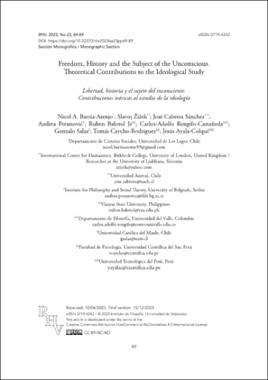
Freedom, History and the Subject of the Unconscious. Theoretical Contributions to the Ideological Study
| dc.contributor.author | Barria-Asenjo, N.A. | |
| dc.contributor.author | Žižek, S. | |
| dc.contributor.author | Sánchez, J.C. | |
| dc.contributor.author | Perunović, A. | |
| dc.contributor.author | Balotol, R. | |
| dc.contributor.author | Rengifo-Castañeda, C.-A. | |
| dc.contributor.author | Salas, G. | |
| dc.contributor.author | Caycho-Rodriguez, T. | |
| dc.contributor.author | Ayala-Colqui, J. | |
| dc.date.accessioned | 2025-10-31T18:38:38Z | |
| dc.date.available | 2025-10-31T18:38:38Z | |
| dc.date.issued | 2023 | |
| dc.identifier.uri | https://hdl.handle.net/20.500.12805/5645 | |
| dc.description.abstract | In this article we address the notions of freedom, history and subjectivity, in order make an original contribution to the studies of ideology. Our methodology will consist in crossing Freudian-Lacanian psychoanalysis and the theory of interpellation of Louis Althusser. In the introduction, we start by exposing two major critiques of Freudian psychoanalysis, one formulated by Jean-Paul Sartre, and the other by Gilles Deleuze and Félix Guattari, thus shedding the light on how the psychoanalysis could represent (despite those critical arguments), a field of freedom rather than determinism, and a domain which is inherently historical, rather than the opposite. In the first section, will look closer at the notions of freedom, memory and history, advancing a preliminary hypothesis according to which within the symbolic space, the past remains open to changes – which will make both ideology and freedom possible. Moreover, we will see what aspects of freedom could be found within the Althusserian theory of interpellation, and how Lacanian psychoanalysis is compatible with it or can lead us beyond its limitations. In the second section, we will see how there can be a subject that precedes subjectivation, and how Lacan’s theory of subject which arises from the traumatic remainder, surpasses the scope of the theory of interpellation. The third section will address the pulse-traumatic core of the subject, such as it is conceived by Freud, not only as a determining dimension of the individual psyche, but as a structural condition of culture. Via these considerations, we will show how psychoanalysis can provide an explanation of the foundations of ideology, by conceiving the pulse-traumatic core of law that resides in the Name-of-Father. In the conclusion, we will see, through a series of examples, how ideology appears in the guise of truth, and why the psychoanalytic understanding of the unconscious is necessary for debunking the illusions it produces. | en_US |
| dc.format | application/pdf | |
| dc.language.iso | eng | |
| dc.publisher | Universidad de Valparaíso | |
| dc.relation.ispartof | urn:issn:0719-4234 | |
| dc.rights | https://purl.org/coar/access_right/c_abf2 | |
| dc.rights.uri | https://creativecommons.org/licenses/by-nc-sa/4.0/ | |
| dc.subject | Philosophical Perspectives on Religion and Community | en_US |
| dc.subject | Sartre's Philosophy of Freedom and Consciousness | en_US |
| dc.title | Freedom, History and the Subject of the Unconscious. Theoretical Contributions to the Ideological Study | en_US |
| dc.type | https://purl.org/coar/resource_type/c_2df8fbb1 | |
| dc.identifier.doi | https://doi.org/10.22370/rhv2023iss23pp69-89 | |
| dc.subject.ocde | https://purl.org/pe-repo/ocde/ford#6.03.01 | |
| dc.type.other | Research article | |
| dc.identifier.journal | Revista de Humanidades de Valparaiso | |
| dc.type.version | https://purl.org/coar/version/c_970fb48d4fbd8a85 |
Files in this item
This item appears in the following Collection(s)
-
Artículos de Investigación [1294]

Except where otherwise noted, this item's license is described as https://purl.org/coar/access_right/c_abf2