Distribución espacio-temporal de aves acuáticas de la familia Laridae en un humedal costero sudamericano
| dc.contributor.author | Minhuey, A. | |
| dc.contributor.author | Podestá, J. | |
| dc.contributor.author | Barona, D. | |
| dc.date.accessioned | 2025-10-31T18:38:35Z | |
| dc.date.available | 2025-10-31T18:38:35Z | |
| dc.date.issued | 2023 | |
| dc.identifier.uri | https://hdl.handle.net/20.500.12805/5640 | |
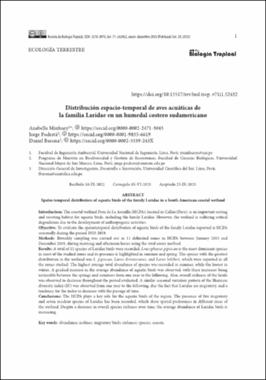
| dc.description.abstract | Introduction: The coastal wetland Poza de La Arenilla (HCPA), located in Callao (Peru), is an important resting and roosting habitat for aquatic birds, including the family Laridae. However, the wetland is suffering critical degradation due to the development of anthropogenic activities. Objective: To evaluate the spatiotemporal distribution of aquatic birds of the family Laridae reported at HCPA seasonally during the period 2013-2018. Methods: Biweekly sampling was carried out in 11 delimited zones in HCPA between January 2013 and December 2018, during morning and afternoon hours using the total count method. Results: A total of 12 species of Laridae birds were recorded. Leucophaeus pipixcan is the most dominant species in most of the studied zones and its presence is highlighted in summer and spring. The species with the greatest distribution in the wetland was L. pipixcan, Larus dominicanus, and L. belcheri, which were reported in all the zones studied. The highest average total abundance of species was recorded in summer, while the lowest in winter. A gradual increase in the average abundance of aquatic birds was observed, with these increases being noticeable between the springs and summers from one year to the following. Also, overall richness of the larids was observed to decrease throughout the period evaluated. A similar seasonal variation pattern of the Shannon diversity index (H’) was observed from one year to the following, due the fact that Laridae are migratory, and a tendency for the index to decrease with the passage of time. Conclusions: The HCPA plays a key role for the aquatic birds of the region. The presence of five migratory and seven resident species of Laridae has been recorded, which show spatial preferences in different areas of the wetland. Despite a decrease in overall species richness over time, the average abundance of Laridae birds is increasing. | en_US |
| dc.format | application/pdf | |
| dc.language.iso | spa | |
| dc.publisher | Universidad de Costa Rica | |
| dc.relation.ispartof | urn:issn:2215-2075 | |
| dc.rights | https://purl.org/coar/access_right/c_abf2 | |
| dc.rights.uri | https://creativecommons.org/licenses/by-nc-sa/4.0/ | |
| dc.subject | Marine Ecosystems and Plastic Waste Management | en_US |
| dc.subject | Wetland Conservation and Biodiversity in Peru | en_US |
| dc.title | Distribución espacio-temporal de aves acuáticas de la familia Laridae en un humedal costero sudamericano | es_PE |
| dc.type | https://purl.org/coar/resource_type/c_2df8fbb1 | |
| dc.identifier.doi | https://doi.org/10.15517/rev.biol.trop..v71i1.52432 | |
| dc.subject.ocde | https://purl.org/pe-repo/ocde/ford#1.06.11 | |
| dc.type.other | Research article | |
| dc.identifier.journal | Revista de Biologia Tropical | |
| dc.type.version | https://purl.org/coar/version/c_970fb48d4fbd8a85 |
Files in this item
This item appears in the following Collection(s)
-
Artículos de Investigación [1294]

Except where otherwise noted, this item's license is described as https://purl.org/coar/access_right/c_abf2