Factores asociados al cribado de Diabetes Mellitus en población Peruana ¿problema para la salud pública?
| dc.contributor.author | Minaya, F.T. | |
| dc.contributor.author | Vera-Ponce, V.J. | |
| dc.contributor.author | Torres-Malca, J.R. | |
| dc.contributor.author | Zuzunaga-Montoya, F.E. | |
| dc.contributor.author | Valencia, J.G. | |
| dc.contributor.author | De La Cruz-Vargas, J.A. | |
| dc.contributor.author | Cruz-Ausejo, L. | |
| dc.date.accessioned | 2025-10-31T18:38:29Z | |
| dc.date.available | 2025-10-31T18:38:29Z | |
| dc.date.issued | 2022 | |
| dc.identifier.uri | https://hdl.handle.net/20.500.12805/5630 | |
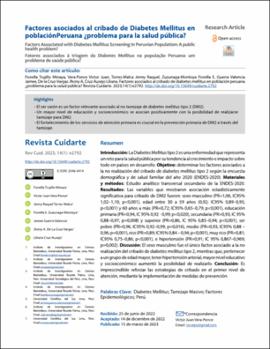
| dc.description.abstract | Introduction: Type 2 Diabetes Mellitus (T2DM) is a disease that poses a challenge to public health due to its growth trend and impact, especially in developing countries. This study aimed to determine the factors associated with not being screened for T2DM according to the 2020 Demographic and Family Health Survey (ENDES-2020). Materials and Methods: Secondary, cross-sectional, analytical study using the ENDES-2020 data. Results: The variables that showed a statistically significant association for T2DM screening were the following: male sex (PR=1.06, 95% CI: 1.02–1.10; p<0.001), ages between 30 and 59 years (0.92, 95% CI: 0.89–0.95; p<0.001) and 60 years and older (PR=0.72, 95% CI: 0.65–0.79; p<0.001), primary education (PR=0.94, 95% CI: 0.92–0.99; p<0.020), secondary education (PR=0.93, 95% CI: 0.88–0.97; p=0.008) higher education (PR=0.86, 95% CI: 0.85–0.94; p<0.001), poor (PR=0.96, 95% CI: 0.92–0.99; p=0.016), middle income (PR=0.93, 95% CI: 0.88–0.96; p=0.001), rich (PR=0.89, 95% CI: 0.84–0.94; p<0.001), very rich (PR=0.81, 95% CI: 0.75–0.86; p<0.001), and hypertension (PR=0.91, 95% CI: 0.867–0.969; p=0.002). Discussion: Being male was the only factor associated with not being screened for T2DM, whereas belonging to an older age group, having arterial hypertension, and having higher education and socioeconomic levels increased the possibility of being screened. Conclusion: It is essential to strengthening screening strategies at the primary level of care by implementing preventive measures. | en_US |
| dc.format | application/pdf | |
| dc.language.iso | spa | |
| dc.publisher | Universidad de Santander | |
| dc.relation.ispartof | urn:issn:2216-0973 | |
| dc.rights | https://purl.org/coar/access_right/c_abf2 | |
| dc.rights.uri | https://creativecommons.org/licenses/by-nc-sa/4.0/ | |
| dc.subject | SDG 3 | en_US |
| dc.subject | Innovative Approaches in Diabetes Management and Monitoring | en_US |
| dc.subject | Diabetes Risk Assessment and Prevention Strategies | en_US |
| dc.title | Factores asociados al cribado de Diabetes Mellitus en población Peruana ¿problema para la salud pública? | es_PE |
| dc.type | https://purl.org/coar/resource_type/c_2df8fbb1 | |
| dc.identifier.doi | https://doi.org/10.15649/CUIDARTE.2792 | |
| dc.subject.ocde | https://purl.org/pe-repo/ocde/ford#3.03.05 | |
| dc.type.other | Research article | |
| dc.identifier.journal | Revista Cuidarte | |
| dc.type.version | https://purl.org/coar/version/c_970fb48d4fbd8a85 |
Files in this item
This item appears in the following Collection(s)
-
Artículos de Investigación [1294]

Except where otherwise noted, this item's license is described as https://purl.org/coar/access_right/c_abf2