Propiedades psicométricas y estructura factorial del cuestionario de salud del paciente PHQ-4 en estudiantes universitarios ecuatorianos
| dc.contributor.author | Guerra, V.L. | |
| dc.contributor.author | Mejia, Á.J.A. | |
| dc.contributor.author | Alcedo, J.M.G. | |
| dc.date.accessioned | 2025-10-31T18:38:14Z | |
| dc.date.available | 2025-10-31T18:38:14Z | |
| dc.date.issued | 2022 | |
| dc.identifier.uri | https://revenfermeria.sld.cu/index.php/enf/article/view/4885 | |
| dc.identifier.uri | https://hdl.handle.net/20.500.12805/5603 | |
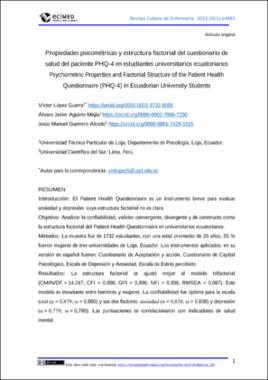
| dc.description.abstract | Introduction: The Patient Health Questionnaire is a brief instrument for assessing anxiety and depression, whose factorial structure is not clear. Objective: To analyze the reliability, convergent, divergent and construct validity, as well as the factorial structure, of the Patient Health Questionnaire in Ecuadorian university students. Methods: The sample consisted of 1732 students, with an average age of twenty years. 55 % were women from three universities in Loja. The instruments applied were the Acceptance and Action Questionnaire, the Psychological Capital Questionnaire, the Depression and Anxiety Scale, and the Perceived Stress Scale. Results: The factorial structure was better adjusted to the bifactorial model (CMIN/DF=14.247; CFI = 0.996; GFI = 0.996; NFI = 0.996, RMSEA = 0.087). This model is invariant between men and women. Reliability was optimal for the total scale (α=0.879; ω=0.880) and its two factors: anxiety (α=0.838; ω=0.838) and depression (α=0.779; ω=0.780). Scores were correlated with mental health indicators. Conclusions: The Patient Health Questionnaire is a scale with optimal psychometric properties for Ecuadorian university students, presenting a bifactorial structure. | en_US |
| dc.description.abstract | Introducción: El Patient Health Questionnaire es un instrumento breve para evaluar ansiedad y depresión, cuya estructura factorial no es clara. Objetivo: Analizar la confiabilidad, validez convergente, divergente y de constructo como la estructura factorial del Patient Health Questionnaire en universitarios ecuatorianos. Métodos: La muestra fue de 1732 estudiantes, con una edad promedio de 20 años; 55 % fueron mujeres de tres universidades de Loja, Ecuador. Los instrumentos aplicados, en su versión en español fueron: Cuestionario de Aceptación y acción, Cuestionario de Capital Psicológico, Escala de Depresión y Ansiedad, Escala de Estrés percibido. Resultados: La estructura factorial se ajustó mejor al modelo bifactorial (CMIN/DF = 14,247; CFI = 0,996; GFI = 0,996; NFI = 0,996, RMSEA = 0,087). Este modelo es invariante entre hombres y mujeres. La confiabilidad fue óptima para la escala total (α = 0,879; ω = 0,880) y sus dos factores: ansiedad (α = 0,838; ω = 0,838) y depresión (α = 0,779; ω = 0,780). Las puntuaciones se correlacionaron con indicadores de salud mental. Conclusiones: El Patient Health Questionnaire es una escala con propiedades psicométricas óptimas para estudiantes universitarios ecuatorianos, que presenta una estructura de dos factores. | es_PE |
| dc.format | application/pdf | |
| dc.language.iso | spa | |
| dc.publisher | Editorial Ciencias Médicas | |
| dc.relation.ispartof | urn:issn:0864-0319 | |
| dc.rights | https://purl.org/coar/access_right/c_abf2 | |
| dc.rights.uri | https://creativecommons.org/licenses/by-nc-sa/4.0/ | |
| dc.subject | ADHD and Associated Neuropsychiatric Disorders | en_US |
| dc.subject | Vigilance Regulation and Brain Arousal in Disorders | en_US |
| dc.title | Propiedades psicométricas y estructura factorial del cuestionario de salud del paciente PHQ-4 en estudiantes universitarios ecuatorianos | es_PE |
| dc.title.alternative | Psychometric Properties and Factorial Structure of the Patient Health Questionnaire (PHQ-4) in Ecuadorian University Students | en_US |
| dc.type | https://purl.org/coar/resource_type/c_2df8fbb1 | |
| dc.subject.ocde | https://purl.org/pe-repo/ocde/ford#5.01.01 | |
| dc.type.other | Research article | |
| dc.identifier.journal | Revista Cubana de Enfermería | |
| dc.type.version | https://purl.org/coar/version/c_970fb48d4fbd8a85 |
Files in this item
This item appears in the following Collection(s)
-
Artículos de Investigación [1294]

Except where otherwise noted, this item's license is described as https://purl.org/coar/access_right/c_abf2