Diversidad alimentaria en habitantes de tres provincias de Perú durante la COVID-19 y factores asociados
| dc.contributor.author | Mamani-Urrutia, V. | |
| dc.contributor.author | Olivares-Etchebaster, M. | |
| dc.contributor.author | Tume, F. | |
| dc.contributor.author | Becerra-Castillo, S.G. | |
| dc.contributor.author | Apaza-Panca, C.M. | |
| dc.contributor.author | Espinoza-Rojas, R. | |
| dc.date.accessioned | 2025-10-31T18:38:09Z | |
| dc.date.available | 2025-10-31T18:38:09Z | |
| dc.date.issued | 2022 | |
| dc.identifier.uri | https://hdl.handle.net/20.500.12805/5594 | |
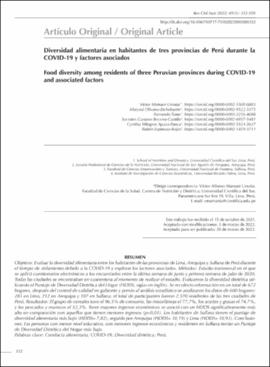
| dc.description.abstract | Objective: To evaluate dietary diversity among the inhabitants of the Peruvian provinces of Lima, Arequipa and Sullana during the time of isolation due to COVID-19 and to explore the associated factors. Methods: Cross-sectional study in which electronic questionnaires were applied to respondents between the last week of June and the first week of July 2020. All cities were in quarantine at the time of the study. We assessed dietary diversity using the Household Dietary Diversity Score (HDDS). Information was collected from a total of 672 households, after quality control and prior to statistical analysis, data from 600 households were analyzed: 281 from Lima, 212 from Arequipa and 107 from Sullana, representing 2,570 residents of the three Peruvian cities. Results: The group of cereals had 96.5% of consumption, miscellaneous 77.7%, oils and fats 74.7%, and fish and shellfish 52.3%. Having higher economic income was associated with a significantly higher HDDS compared to those with lower income (p<0.01). The inhabitants of Sullana have the lowest dietary diversity score (HDDS= 7.82), followed by Arequipa (HDDS= 10.19) and Lima (HDDS= 10.93). Conclusions: People with a lower educational level, with lower economic income and residents of Sullana had a lower Household Dietary Diversity Score. | en_US |
| dc.format | application/pdf | |
| dc.language.iso | spa | |
| dc.publisher | Sociedad Chilena de Nutrición, Bromatología y Toxicología | |
| dc.relation.ispartof | urn:issn:0717-7518 | |
| dc.rights | https://purl.org/coar/access_right/c_abf2 | |
| dc.rights.uri | https://creativecommons.org/licenses/by-nc-sa/4.0/ | |
| dc.subject | SDG 3 | en_US |
| dc.subject | Sustainable Food Systems and Waste Reduction Strategies | en_US |
| dc.subject | Food Security and Supply Chain Resilience During COVID-19 | en_US |
| dc.title | Diversidad alimentaria en habitantes de tres provincias de Perú durante la COVID-19 y factores asociados | es_PE |
| dc.type | https://purl.org/coar/resource_type/c_2df8fbb1 | |
| dc.identifier.doi | https://doi.org/10.4067/s0717-75182022000300352 | |
| dc.subject.ocde | https://purl.org/pe-repo/ocde/ford#3.03.04 | |
| dc.type.other | Research article | |
| dc.identifier.journal | Revista Chilena de Nutricion | |
| dc.type.version | https://purl.org/coar/version/c_970fb48d4fbd8a85 |
Files in this item
This item appears in the following Collection(s)
-
Artículos de Investigación [1294]

Except where otherwise noted, this item's license is described as https://purl.org/coar/access_right/c_abf2