Socio-demographic, migratory and health-related determinants of food insecurity among Venezuelan migrants in Peru
| dc.contributor.author | Al-Kassab-Córdova, A. | |
| dc.contributor.author | Villarreal-Zegarra, D. | |
| dc.contributor.author | Bendezu-Quispe, G. | |
| dc.contributor.author | Robles-Valcárcel, P. | |
| dc.contributor.author | Herrera-Añazco, P. | |
| dc.contributor.author | Benites-Zapata, V.A. | |
| dc.date.accessioned | 2025-10-31T18:37:55Z | |
| dc.date.available | 2025-10-31T18:37:55Z | |
| dc.date.issued | 2023 | |
| dc.identifier.uri | https://hdl.handle.net/20.500.12805/5571 | |
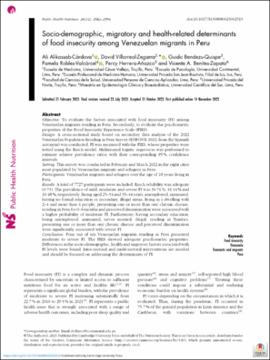
| dc.description.abstract | Objective: To evaluate the factors associated with food insecurity (FI) among Venezuelan migrants residing in Peru. Secondarily, to evaluate the psychometric properties of the Food Insecurity Experience Scale (FIES). Design: A cross-sectional study based on secondary data analysis of the 2022 Venezuelan Population Residing in Peru Survey (ENPOVE-2022, from the Spanish acronym) was conducted. FI was measured with the FIES, whose properties were tested using the Rasch model. Multinomial logistic regression was performed to estimate relative prevalence ratios with their corresponding 95 % confidence intervals. Setting: This survey was conducted in February and March 2022 in the eight cities most populated by Venezuelan migrants and refugees in Peru. Participants: Venezuelan migrants and refugees over the age of 18 years living in Peru. Results: A total of 7727 participants were included. Rasch reliability was adequate (0·73). The prevalence of mild, moderate and severe FI was 36·71 %, 31·14 % and 10·48 %, respectively. Being aged 25-34 and 35-44 years, unemployed, uninsured, having no formal education or secondary, illegal status, living in a dwelling with 2-4 and more than 4 people, presenting one or more than one chronic disease, residing in Peru for 0-6 months and perceived discrimination were associated with a higher probability of moderate FI. Furthermore, having secondary education, being unemployed, uninsured, never married, illegal, residing in Tumbes, presenting one or more than one chronic disease and perceived discrimination were significantly associated with severe FI. Conclusion: Four out of ten Venezuelan migrants residing in Peru presented moderate to severe FI. The FIES showed adequate psychometric properties. Differences in the socio-demographic, health and migratory factors associated with FI levels were found. Inter-sectoral and multi-sectoral interventions are needed and should be focused on addressing the determinants of FI. | en_US |
| dc.format | application/pdf | |
| dc.language.iso | eng | |
| dc.publisher | Cambridge University Press | |
| dc.relation.ispartof | urn:issn:1475-2727 | |
| dc.rights | https://purl.org/coar/access_right/c_abf2 | |
| dc.rights.uri | https://creativecommons.org/licenses/by-nc-sa/4.0/ | |
| dc.subject | SDG 2 | en_US |
| dc.subject | Nutrition, Food Security, and Family Dynamics | en_US |
| dc.subject | Food Insecurity and Its Impacts | en_US |
| dc.title | Socio-demographic, migratory and health-related determinants of food insecurity among Venezuelan migrants in Peru | en_US |
| dc.type | https://purl.org/coar/resource_type/c_2df8fbb1 | |
| dc.identifier.doi | https://doi.org/10.1017/S1368980023002513 | |
| dc.subject.ocde | https://purl.org/pe-repo/ocde/ford#5.04.05 | |
| dc.type.other | Research article | |
| dc.identifier.journal | Public Health Nutrition | |
| dc.type.version | https://purl.org/coar/version/c_970fb48d4fbd8a85 |
Files in this item
This item appears in the following Collection(s)
-
Artículos de Investigación [1294]

Except where otherwise noted, this item's license is described as https://purl.org/coar/access_right/c_abf2