Socio-economic inequalities in the consumption of fruits and vegetables in Peru between 2014 and 2019
| dc.contributor.author | Hernández-Vásquez, A. | |
| dc.contributor.author | Visconti Lopez, F.J. | |
| dc.contributor.author | Vargas-Fernández, R. | |
| dc.date.accessioned | 2025-10-31T18:37:55Z | |
| dc.date.available | 2025-10-31T18:37:55Z | |
| dc.date.issued | 2022 | |
| dc.identifier.uri | https://hdl.handle.net/20.500.12805/5570 | |
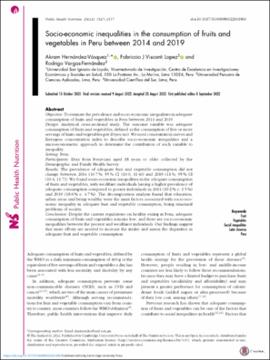
| dc.description.abstract | Objective: To estimate the prevalence and socio-economic inequalities in adequate consumption of fruits and vegetables in Peru between 2014 and 2019. Design: Analytical cross-sectional study. The outcome variable was adequate consumption of fruits and vegetables, defined as the consumption of five or more servings of fruits and vegetables per d (yes/no). We used concentration curves and Erreygers concentration index to describe socio-economic inequalities and a microeconometric approach to determine the contribution of each variable to inequality. Setting: Peru. Participants: Data from Peruvians aged 18 years or older collected by the Demographic and Family Health Survey. Results: The prevalence of adequate fruit and vegetable consumption did not change between 2014 (10.7 %; 95 % CI (10.0, 11.4)) and 2019 (11 %; 95 % CI (10.4, 11.7)). We found socio-economic inequalities in the adequate consumption of fruits and vegetables, with wealthier individuals having a higher prevalence of adequate consumption compared to poorer individuals in 2014 (19.2 % v. 3.5 %) and 2019 (18.6 % v. 4.7 %). The decomposition analysis found that education, urban areas and being wealthy were the main factors associated with socio-economic inequality in adequate fruit and vegetable consumption, being structural problems of society. Conclusion: Despite the current regulations on healthy eating in Peru, adequate consumption of fruits and vegetables remains low, and there are socio-economic inequalities between the poorest and wealthiest individuals. Our findings suggest that more efforts are needed to increase the intake and assess the disparities in adequate fruit and vegetable consumption. | en_US |
| dc.description.sponsorship | This research received no specific grant from any funding agency in the public, commercial or not-for-profit sectors | |
| dc.format | application/pdf | |
| dc.language.iso | eng | |
| dc.publisher | Cambridge University Press | |
| dc.relation.ispartof | urn:issn:1475-2727 | |
| dc.rights | https://purl.org/coar/access_right/c_abf2 | |
| dc.rights.uri | https://creativecommons.org/licenses/by-nc-sa/4.0/ | |
| dc.subject | SDG 1 | en_US |
| dc.subject | SDG 10 | en_US |
| dc.subject | Nutrition, Food Security, and Family Dynamics | en_US |
| dc.subject | Socioeconomic Influences on Healthy Diet Choices | en_US |
| dc.title | Socio-economic inequalities in the consumption of fruits and vegetables in Peru between 2014 and 2019 | en_US |
| dc.type | https://purl.org/coar/resource_type/c_2df8fbb1 | |
| dc.identifier.doi | https://doi.org/10.1017/S1368980022001860 | |
| dc.subject.ocde | https://purl.org/pe-repo/ocde/ford#3.03.05 | |
| dc.type.other | Research article | |
| dc.identifier.journal | Public Health Nutrition | |
| dc.type.version | https://purl.org/coar/version/c_970fb48d4fbd8a85 |
Files in this item
This item appears in the following Collection(s)
-
Artículos de Investigación [1294]

Except where otherwise noted, this item's license is described as https://purl.org/coar/access_right/c_abf2