Combining cash transfers and cognitive behavioral therapy to reduce antisocial behavior in young men: A mediation analysis of a randomized controlled trial in Liberia
| dc.contributor.author | Carpena, M.X. | |
| dc.contributor.author | Paula, C.S. | |
| dc.contributor.author | De Mola, C.L. | |
| dc.contributor.author | Hessel, P. | |
| dc.contributor.author | Avendano, M. | |
| dc.contributor.author | Evans-Lacko, S. | |
| dc.contributor.author | Matijasevich, A. | |
| dc.date.accessioned | 2025-10-31T18:37:44Z | |
| dc.date.available | 2025-10-31T18:37:44Z | |
| dc.date.issued | 2023 | |
| dc.identifier.uri | https://hdl.handle.net/20.500.12805/5552 | |
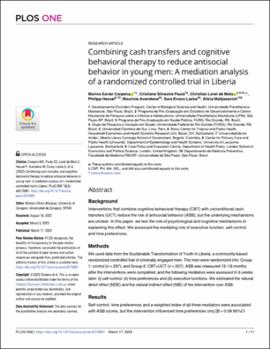
| dc.description.abstract | Background Interventions that combine cognitive behavioral therapy (CBT) with unconditional cash transfers (UCT) reduce the risk of antisocial behavior (ASB), but the underlying mechanisms are unclear. In this paper, we test the role of psychological and cognitive mechanisms in explaining this effect. We assessed the mediating role of executive function, self-control, and time preferences. Methods We used data from the Sustainable Transformation of Youth in Liberia, a community-based randomized controlled trial of criminally engaged men. The men were randomized into: Group-1: control (n = 237); and Group-2: CBT+UCT (n = 207). ASB was measured 12 13 months after the interventions were completed, and the following mediators were assessed 2 5 weeks later: (i) self-control, (ii) time preferences and (iii) executive functions. We estimated the natural direct effect (NDE) and the natural indirect effect (NIE) of the intervention over ASB. Results Self-control, time preferences and a weighted index of all three mediators were associated with ASB scores, but the intervention influenced time preferences only [B = 0.09 95%CI (0.03; 0.15)]. There was no evidence that the effect of the intervention on ASB was mediated by self-control [BNIE = 0.007 95%CI (-0.01; 0.02)], time preferences [BNIE =-0.02 95%CI (-0.05; 0.01)], executive functions [BNIE = 0.002 95%CI (-0.002; 0.006)] or the weighted index of the mediators [BNIE =-0.0005 95%CI (-0.03; 0.02)]. Conclusions UCT and CBT lead to improvements in ASB, even in the absence of mediation via psychological and cognitive functions. Findings suggest that the causal mechanisms may involve non-psychological pathways. | en_US |
| dc.format | application/pdf | |
| dc.language.iso | eng | |
| dc.publisher | Public Library of Science | |
| dc.relation.ispartof | urn:issn:1932-6203 | |
| dc.rights | https://purl.org/coar/access_right/c_abf2 | |
| dc.rights.uri | https://creativecommons.org/licenses/by-nc-sa/4.0/ | |
| dc.subject | Income Inequality and Financial Literacy Dynamics | en_US |
| dc.subject | Conditional Cash Transfers and Child Welfare Impact | en_US |
| dc.title | Combining cash transfers and cognitive behavioral therapy to reduce antisocial behavior in young men: A mediation analysis of a randomized controlled trial in Liberia | en_US |
| dc.type | https://purl.org/coar/resource_type/c_2df8fbb1 | |
| dc.identifier.doi | https://doi.org/10.1371/journal.pone.0273891 | |
| dc.subject.ocde | https://purl.org/pe-repo/ocde/ford#5.01.01 | |
| dc.type.other | Research article | |
| dc.identifier.journal | PLoS ONE | |
| dc.type.version | https://purl.org/coar/version/c_970fb48d4fbd8a85 |
Files in this item
This item appears in the following Collection(s)
-
Artículos de Investigación [1294]

Except where otherwise noted, this item's license is described as https://purl.org/coar/access_right/c_abf2