Psychometric properties and factorial structure of the Spanish version of the psychological capital scale in Ecuadorian university students
| dc.contributor.author | López-Guerra, V. | |
| dc.contributor.author | Ocampo-Vásquez, K. | |
| dc.contributor.author | Quinde, L. | |
| dc.contributor.author | Mora, S.G. | |
| dc.contributor.author | Guerrero-Alced, J. | |
| dc.date.accessioned | 2025-10-31T18:37:44Z | |
| dc.date.available | 2025-10-31T18:37:44Z | |
| dc.date.issued | 2023 | |
| dc.identifier.uri | https://hdl.handle.net/20.500.12805/5551 | |
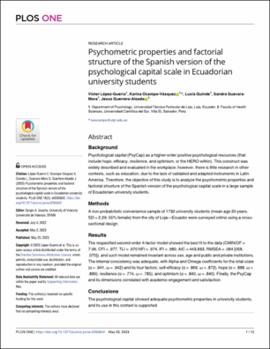
| dc.description.abstract | Background Psychological capital (PsyCap) as a higher-order positive psychological resources (that include hope, efficacy, resilience, and optimism, or the HERO within). This construct was widely described and evaluated in the workplace; however, there is little research in other contexts, such as education, due to the lack of validated and adapted instruments in Latin America. Therefore, the objective of this study is to analyze the psychometric properties and factorial structure of the Spanish version of the psychological capital scale in a large sample of Ecuadorian university students. Methods A non-probabilistic convenience sample of 1732 university students (mean age 20 years, SD = 2,29; 55% female) from the city of Loja - Ecuador were surveyed online using a crosssectional design. Results The respecified second-order 4-factor model showed the best fit to the data (CMIN/DF = 7.99, CFI = .977, TLI = .970 NFI = .974, IFI = .980, AIC = 443.833, RMSEA = .064 [058, .070]), and such model remained invariant across sex, age and public and private institutions. The internal consistency was adequate, with Alpha and Omega coefficients for the total scale (α = .941, ω = .942) and its four factors: self-efficacy (α = .869, ω = .872), hope (α = .888, ω = .889), resilience (α = .774, ω = .785), and optimism (α = .840, ω = .840). Finally, the PsyCap and its dimensions correlated with academic engagement and satisfaction. Conclusions The psychological capital showed adequate psychometric properties in university students, and its use in this context is supported. | en_US |
| dc.format | application/pdf | |
| dc.language.iso | eng | |
| dc.publisher | Public Library of Science | |
| dc.relation.ispartof | urn:issn:1932-6203 | |
| dc.rights | https://purl.org/coar/access_right/c_abf2 | |
| dc.rights.uri | https://creativecommons.org/licenses/by-nc-sa/4.0/ | |
| dc.subject | Emotional Wellbeing and Life Satisfaction Insights | en_US |
| dc.subject | Psychological Capital and Employee Performance Dynamics | en_US |
| dc.title | Psychometric properties and factorial structure of the Spanish version of the psychological capital scale in Ecuadorian university students | en_US |
| dc.type | https://purl.org/coar/resource_type/c_2df8fbb1 | |
| dc.identifier.doi | https://doi.org/10.1371/journal.pone.0285842 | |
| dc.subject.ocde | https://purl.org/pe-repo/ocde/ford#5.01.01 | |
| dc.type.other | Research article | |
| dc.identifier.journal | PLoS ONE | |
| dc.type.version | https://purl.org/coar/version/c_970fb48d4fbd8a85 |
Files in this item
This item appears in the following Collection(s)
-
Artículos de Investigación [1294]

Except where otherwise noted, this item's license is described as https://purl.org/coar/access_right/c_abf2