Nutritional status and effective verbal communication in Peruvian children: A secondary analysis of the 2019 Demographic and Health Survey
| dc.contributor.author | Hernández-Vásquez, A. | |
| dc.contributor.author | Pisfil-Benites, N. | |
| dc.contributor.author | Vargas-Fernández, R. | |
| dc.contributor.author | Azañedo, D. | |
| dc.date.accessioned | 2025-10-31T18:37:41Z | |
| dc.date.available | 2025-10-31T18:37:41Z | |
| dc.date.issued | 2021 | |
| dc.identifier.uri | https://hdl.handle.net/20.500.12805/5546 | |
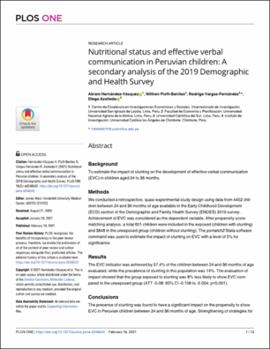
| dc.description.abstract | Background To estimate the impact of stunting on the development of effective verbal communication (EVC) in children aged 24 to 36 months. Methods We conducted a retrospective, quasi-experimental study design using data from 4452 children between 24 and 36 months of age available in the Early Childhood Development (ECD) section of the Demographic and Family Health Survey (ENDES) 2019 survey. Achievement of EVC was considered as the dependent variable. After propensity score matching analysis, a total 601 children were included in the exposed (children with stunting) and 3848 in the unexposed group (children without stunting). The psmatch2 Stata software command was used to estimate the impact of stunting on EVC with a level of 5% for significance. Results The EVC indicator was achieved by 57.4% of the children between 24 and 36 months of age evaluated, while the prevalence of stunting in this population was 14%. The evaluation of impact showed that the group exposed to stunting was 8% less likely to show EVC compared to the unexposed group (ATT -0.08; 95% CI -0.106 to -0.054; p<0.001). Conclusions The presence of stunting was found to have a significant impact on the propensity to show EVC in Peruvian children between 24 and 36 months of age. Strengthening of strategies for reducing malnutrition in vulnerable areas, as well as those directly affecting EVC is a priority for diminishing gaps in the achievement of this indicator in our country. | en_US |
| dc.format | application/pdf | |
| dc.language.iso | eng | |
| dc.publisher | Public Library of Science | |
| dc.relation.ispartof | urn:issn:1932-6203 | |
| dc.rights | https://purl.org/coar/access_right/c_abf2 | |
| dc.rights.uri | https://creativecommons.org/licenses/by-nc-sa/4.0/ | |
| dc.subject | SDG 2 | en_US |
| dc.subject | Malnutrition and Growth Patterns in Children | en_US |
| dc.subject | Addressing Child Malnutrition and Nutritional Status | en_US |
| dc.title | Nutritional status and effective verbal communication in Peruvian children: A secondary analysis of the 2019 Demographic and Health Survey | en_US |
| dc.type | https://purl.org/coar/resource_type/c_2df8fbb1 | |
| dc.identifier.doi | https://doi.org/10.1371/journal.pone.0246542 | |
| dc.subject.ocde | https://purl.org/pe-repo/ocde/ford#3.03.04 | |
| dc.type.other | Research article | |
| dc.identifier.journal | PLoS ONE | |
| dc.type.version | https://purl.org/coar/version/c_970fb48d4fbd8a85 |
Files in this item
This item appears in the following Collection(s)
-
Artículos de Investigación [1294]

Except where otherwise noted, this item's license is described as https://purl.org/coar/access_right/c_abf2