Prevalence and incidence of diabetic peripheral neuropathy in Latin America and the Caribbean: A systematic review and metaanalysis
| dc.contributor.author | Yovera-Aldana, M. | |
| dc.contributor.author | Velasquez-Rimachi, V. | |
| dc.contributor.author | Huerta-Rosario, A. | |
| dc.contributor.author | More-Yupanqui, M.D. | |
| dc.contributor.author | Osores-Flores, M. | |
| dc.contributor.author | Espinoza, R. | |
| dc.contributor.author | Gil-Olivares, F. | |
| dc.contributor.author | Quispe-Nolazco, C. | |
| dc.contributor.author | Quea-Velez, F. | |
| dc.contributor.author | Moran-Mariños, C. | |
| dc.contributor.author | Pinedo-Torres, I. | |
| dc.contributor.author | Alva-Diaz, C. | |
| dc.contributor.author | Pacheco-Barrios, K. | |
| dc.date.accessioned | 2025-10-31T18:37:39Z | |
| dc.date.available | 2025-10-31T18:37:39Z | |
| dc.date.issued | 2021 | |
| dc.identifier.uri | https://hdl.handle.net/20.500.12805/5543 | |
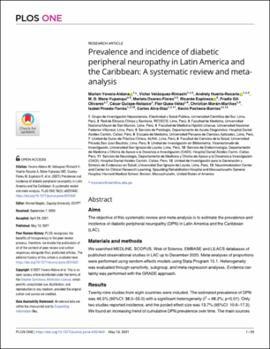
| dc.description.abstract | Aims The objective of this systematic review and meta-analysis is to estimate the prevalence and incidence of diabetic peripheral neuropathy (DPN) in Latin America and the Caribbean (LAC). Materials and methods We searched MEDLINE, SCOPUS, Web of Science, EMBASE and LILACS databases of published observational studies in LAC up to December 2020. Meta-analyses of proportions were performed using random-effects models using Stata Program 15.1. Heterogeneity was evaluated through sensitivity, subgroup, and meta-regression analyses. Evidence certainty was performed with the GRADE approach. Results Twenty-nine studies from eight countries were included. The estimated prevalence of DPN was 46.5% (95%CI: 38.0-55.0) with a significant heterogeneity (I2 = 98.2%; p<0.01). Only two studies reported incidence, and the pooled effect size was 13.7% (95%CI: 10.6-17.2). We found an increasing trend of cumulative DPN prevalence over time. The main sources of heterogeneity associated with higher prevalence were diagnosis criteria, higher A1c (%), and inadequate sample size. We judge the included evidence as very low certainty. Conclusion The overall prevalence of DPN is high in LAC with significant heterogeneity between and within countries that could be explained by population type and methodological aspects. Significant gaps (e.g., under-representation of most countries, lack of incidence studies, and heterogenous case definition) were identified. Standardized and population-based studies of DPN in LAC are needed. | en_US |
| dc.format | application/pdf | |
| dc.language.iso | eng | |
| dc.publisher | Public Library of Science | |
| dc.relation.ispartof | urn:issn:1932-6203 | |
| dc.rights | https://purl.org/coar/access_right/c_abf2 | |
| dc.rights.uri | https://creativecommons.org/licenses/by-nc-sa/4.0/ | |
| dc.subject | SDG 3 | en_US |
| dc.subject | Diabetes and Its Complications in Foot Health | en_US |
| dc.subject | Diabetic Neuropathy and Nerve Fiber Dynamics | en_US |
| dc.title | Prevalence and incidence of diabetic peripheral neuropathy in Latin America and the Caribbean: A systematic review and metaanalysis | en_US |
| dc.type | https://purl.org/coar/resource_type/c_2df8fbb1 | |
| dc.identifier.doi | https://doi.org/10.1371/journal.pone.0251642 | |
| dc.subject.ocde | https://purl.org/pe-repo/ocde/ford#3.02.25 | |
| dc.type.other | Research article | |
| dc.identifier.journal | PLoS ONE | |
| dc.type.version | https://purl.org/coar/version/c_970fb48d4fbd8a85 |
Files in this item
This item appears in the following Collection(s)
-
Artículos de Investigación [1294]

Except where otherwise noted, this item's license is described as https://purl.org/coar/access_right/c_abf2